From a Steel Subsidiary to the Chairman's Chair: How Anand Mahindra Learned the Group From the Edges
He did not begin at the flagship. He began at a small steel unit, and the route shaped how he leads a group that now reports nearly Rs 2 lakh crore in annual revenue.
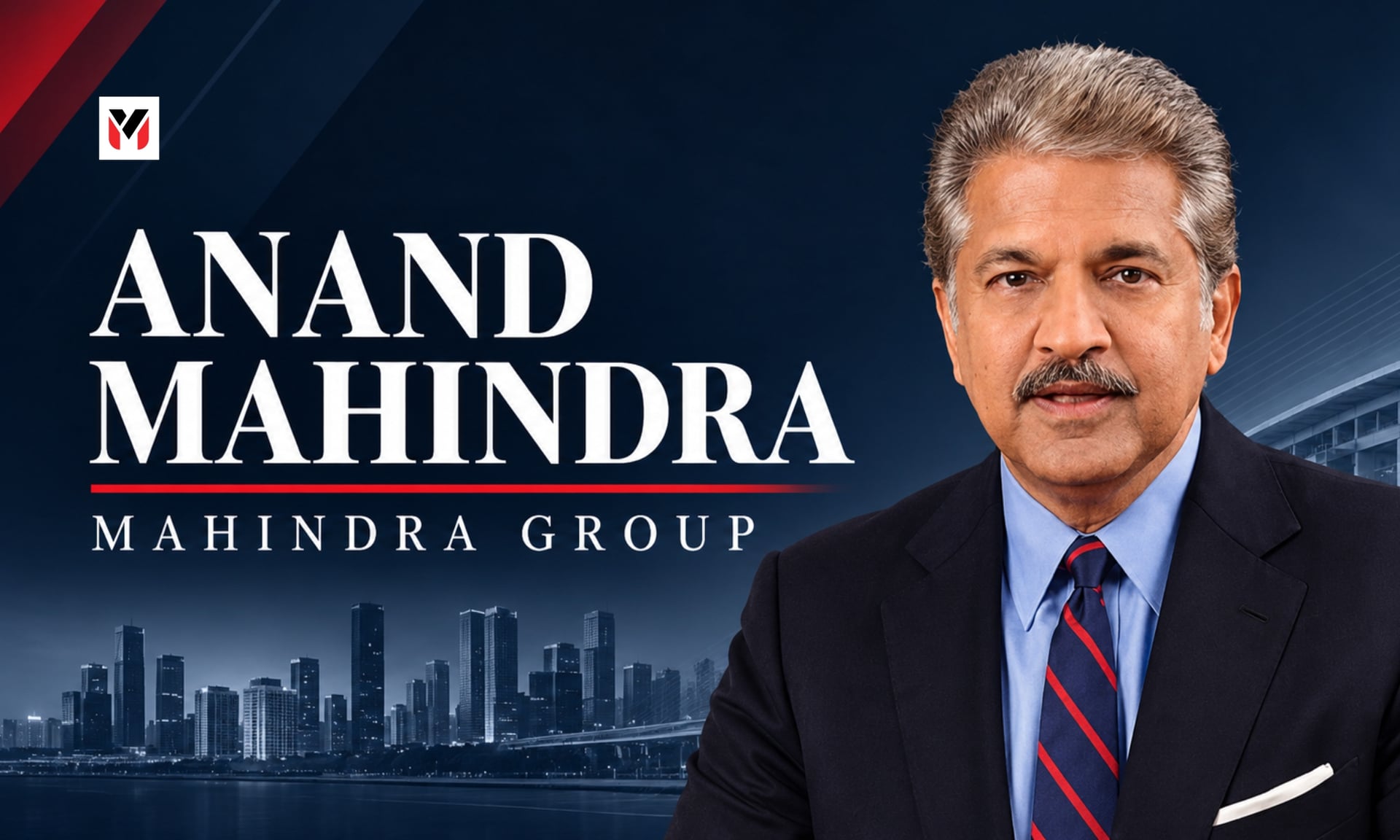
Anand Mahindra, Chairman of the Mahindra Group · Editorial · Independent profile preview.
Apprenticeship on the Edges: MUSCO to Managing Director
Anand Mahindra studied at The Lawrence School, Lovedale, then at Harvard University, graduating magna cum laude in 1977, and took an MBA at Harvard Business School in 1981. He began at Mahindra Ugine Steel Company (MUSCO), a group steel business, in 1981. By 1989 he was president and deputy managing director there. In April 1991 he became deputy managing director of Mahindra & Mahindra, and in April 1997 its managing director. He became vice chairman in 2001, and in August 2012 chairman and managing director of the group, succeeding his uncle Keshub Mahindra. In November 2016 he moved to the role of executive chairman of Mahindra & Mahindra while remaining group chairman.
Ventures Beyond the Core and Enduring Social Impact
Public records show a leader who kept placing bets away from the flagship vehicle and tractor business. At MUSCO he oversaw diversification into real estate and hospitality. In 1996 he founded Nanhi Kali, an NGO that supports girls' education. In 2014 he co-launched the Pro Kabaddi League, and the same year co-founded the EPIC TV channel, which he fully owned from 2016. Honours include Knight of the Legion of Honour (2016), Forbes India Entrepreneur of the Year (2013), a place on Fortune's 2014 list of the World's 50 Greatest Leaders, and the Padma Bhushan (January 2020).
“The Group is well poised to accelerate in these uncertain times.”
FY26 Performance: Nearing Rs 2 Lakh Crore Revenue
The board approved results for the year to 31 March 2026 on 5 May 2026. The group's consolidated revenue was Rs 198,639 crore, up 25% from Rs 159,211 crore, and profit after tax was Rs 17,099 crore, up 32% (the company's headline said 35% excluding land-sale gains of Rs 304 crore in FY25). Return on equity was 20.1%, and the dividend was Rs 33 a share, up 30%.
Auto. Consolidated auto revenue was Rs 117,834 crore, up 30%, with volumes up 19% and profit after tax of Rs 7,842 crore. SUV revenue market share was 25.3% in FY26, up 260 basis points.
Farm. Revenue was Rs 42,568 crore, up 20%, with profit after tax of Rs 4,298 crore. Tractor market share was 43.6%, up 30 basis points; in the fourth quarter, the farm business sold 120,000 tractors, up 36%.
These results come from Mahindra & Mahindra's own press release. The company's Group CEO and managing director, Dr Anish Shah, called FY26 a "defining year" and said the group is "well poised to accelerate in these uncertain times."
The Chairman-CEO Dual Structure & Leadership Lessons
The pattern is a chairman who sets direction and a professional chief executive who runs the group day to day, a structure also visible at HCLTech and Infosys. For Mahindra, it separates the public voice and long-range thinking of the chairman from the quarterly discipline of the management team. It is an example of what we describe in our Leadership Lessons piece on staged handovers.
What readers can take from the profile: 1. Start where learning is fastest. A small steel subsidiary taught him about operations before the flagship. 2. A strong core can fund curiosity at the edges, if each bet has an owner. 3. Long-run social programmes work best when they last. Nanhi Kali began in 1996. 4. Let the CEO run the company. A separate chief executive allows the chairman to look further ahead.
Why Decentralised Discipline Scales
A group of this size is really several businesses with different rhythms. Vehicles are cyclical and depend on launches and commodity costs. Tractors follow the monsoon and rural incomes. Financial services follow interest rates and credit quality. A chairman who tries to run all of them directly will be pulled in too many directions, which is why the separation between a long-range chairman and an operating chief executive matters. It leaves one person free to ask what the group should look like in a decade and another to ensure that this quarter's numbers are met.
The FY26 figures also show the benefit of leadership in the two largest businesses at once. Growth of 25% in revenue across a group this size does not come from a single product; it comes from SUVs, tractors and a dozen smaller bets all working in the same year, which is a hard thing to arrange and a harder thing to repeat.
Independent editorial profile built from public reporting and company results.
- Mahindra & Mahindra, 'M&M Results Q4 F26 and FY26', 5 May 2026
- Wikipedia, 'Anand Mahindra' (career, honours; page data runs to Oct 2024)
The Editorial Desk
Perspectives on the people, ideas and businesses shaping what comes next. The articles in this preview are illustrative samples, not reported journalism.
More from the Editorial Desk