The Engineer Who Ran the House of Tata, and the Succession Question He Leaves Behind
He began in a Tamil-medium government school and ended up chairing one of the world's best-known business groups. In 2026 he said he would not seek another term.
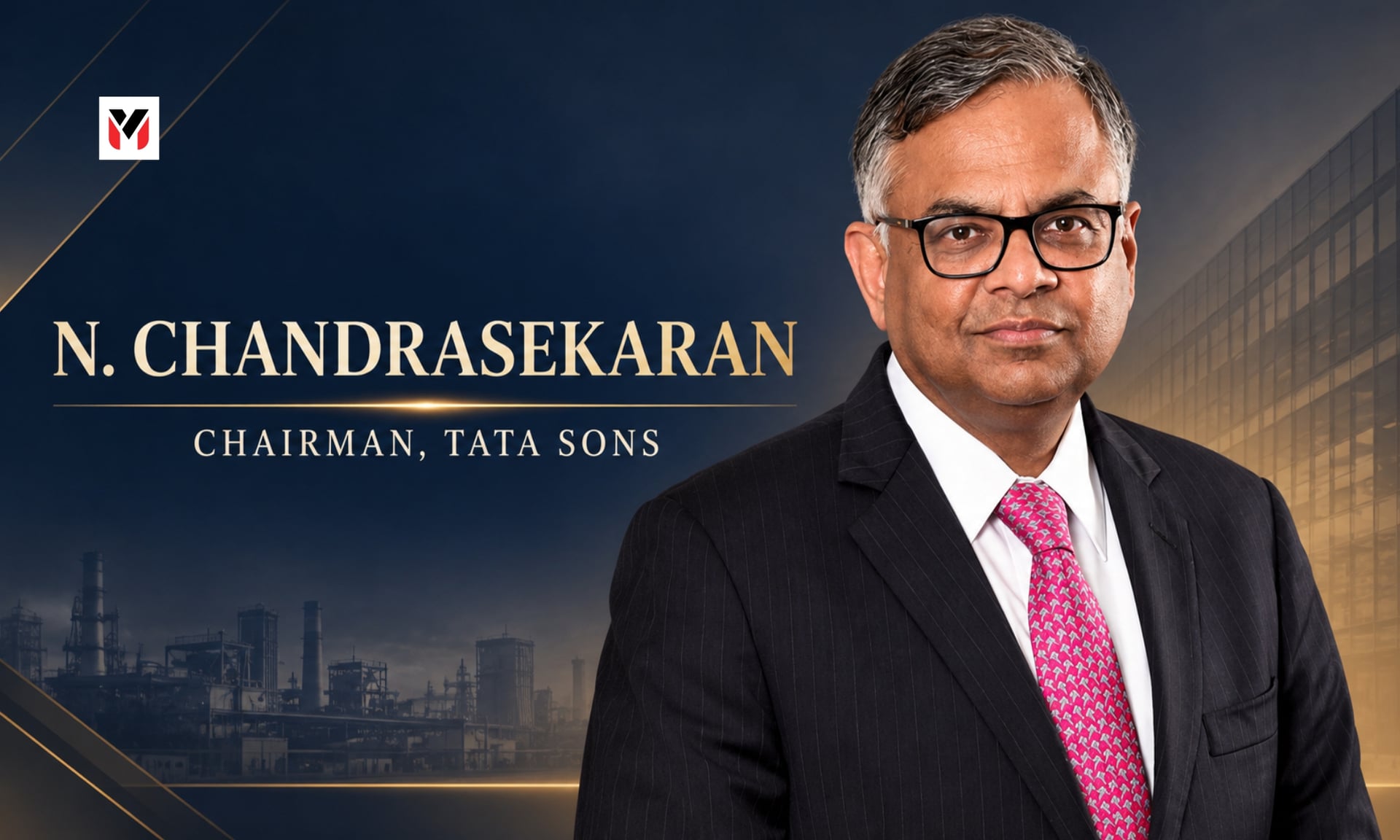
N. Chandrasekaran, Chairman of Tata Sons · Editorial · Independent profile preview.
From Mohanur to TCS Leadership
N. Chandrasekaran was born on 2 June 1963 in Mohanur, a town in what is now Tamil Nadu, and attended a Tamil-medium government school there. He studied applied sciences at Coimbatore Institute of Technology and took a Master of Computer Applications at the Regional Engineering College in Tiruchirappalli (now NIT Trichy), finishing in 1986. He joined Tata Consultancy Services in 1987.
Over two decades he rose through the ranks, becoming chief operating officer and executive director, and on 6 October 2009 he became the chief executive of TCS. Reuters has noted that TCS provides most of Tata Sons' dividend income, which explains why the company he ran for years sits at the centre of the group's finances.
Chairman of Tata Sons and Global Recognition
In October 2016 the Tata Sons board removed Cyrus Mistry as chairman, and Chandrasekaran became chairman of Tata Sons in early 2017, described as the first professional executive and first non-Parsi to hold the job. The dispute with Mistry went through the National Company Law Tribunal, the appellate tribunal and the Supreme Court. In January 2020, a three-judge Supreme Court bench stayed an order that had declared his appointment illegal. He also chaired B20 India during India's 2023 G20 presidency and was appointed to the Reserve Bank of India board in 2016.
His honours include the Padma Bhushan (2022), France's Legion of Honour (2023), an EY Entrepreneur of the Year special jury award (2023 India edition, announced February 2024) and, in March 2026, an honorary British knighthood for work on India-UK business ties.
“The Tata Group's next chapter will be decided as much in a boardroom as in a factory.”
The 2026 Governance Crossroads
In August 2026, reports said that he would not seek reappointment when his term ends on 20 February 2027. Reuters and The Economic Times, as relayed by Open magazine, linked the decision to tension over his reappointment and the group's future governance, including whether Tata Sons should ever be listed. The Economic Times also reported that concerns had been raised about losses at newer ventures such as Air India. Neither Chandrasekaran nor Tata Sons gave a public reason at the time of that report.
On 18 August 2026, IANS reported, the Tata Sons annual general meeting was called off for lack of quorum, the first time the company had deferred an AGM. NDTV Profit, cited in the same report, linked the shortfall to a restriction involving the Sir Ratan Tata Trust. By then the Sir Dorabji Tata Trust had begun the search for a successor, and the appointment is to follow a committee process set out in the company's articles of association. Tata Trusts hold roughly two-thirds of Tata Sons according to IANS. Noel Tata, chairman of Tata Trusts, is described as a key figure in the selection and is reported to be due to retire from the boards of six Tata companies in November, on turning 70.
What Business Readers and Suppliers Should Watch
What business readers should watch: 1. The selection process. The committee's recommendation, and whether the board accepts it, will show how the owners resolve their differences. 2. The AGM. The rescheduled meeting is the next formal test of whether shareholders can act together. 3. TCS. As the group's main source of dividends, it matters whether the company stays insulated from the transition. 4. The listing question. Whether Tata Sons stays unlisted shapes disclosure and accountability across the group.
For MSMEs and suppliers: Tata companies sit at the top of thousands of supplier chains, from auto components in Pune to steel and IT services across India. A change at the top does not change purchase orders overnight, but over two years it can shift priorities on capital spending, supplier policies and payment practice. Keep an eye on procurement announcements from your anchor customer.
Consensus, Governance and Leadership Lessons
Taken together, the public record shows a leader who is hard to place in a single category. He is an engineer who rose through a services company, a chairman who inherited a contested succession, and a group head who has had to balance an ownership structure in which charitable trusts hold the controlling stake. That last point is unusual. In most listed conglomerates, the largest shareholder is a family or a state body; at Tata Sons, the trusts have a public-purpose mandate, and the chairman answers to a board where trustee nominees have real influence. Any chairman in that position needs consensus as much as authority, and the events of 2026 show how fragile consensus can be.
For readers who run or advise companies, the practical lesson is the one our governance coverage keeps returning to: write down how succession works before it is needed, and make sure the people who own the company agree on it.
Independent editorial profile built from public reporting. We have not interviewed Mr Chandrasekaran.
- Wikipedia, 'Natarajan Chandrasekaran' (biography, honours)
- Open Magazine, 12 Aug 2026; IANS, 'Tata Sons AGM deferred for first time over quorum shortfall', 18 Aug 2026; Moneylife, Tata Trusts selection process report
- Note: different sources use 'resigns', 'steps down' and 'will not seek reappointment'; our copy says 'would not seek reappointment when his term ends'.
The Editorial Desk
Perspectives on the people, ideas and businesses shaping what comes next. The articles in this preview are illustrative samples, not reported journalism.
More from the Editorial Desk