She Joined as a Trainee, Left as the Boss: Arundhati Bhattacharya's 36 Years at SBI
A literature major who passed a bank exam in 1977 ended up running the biggest lender in India and overseeing its largest merger.
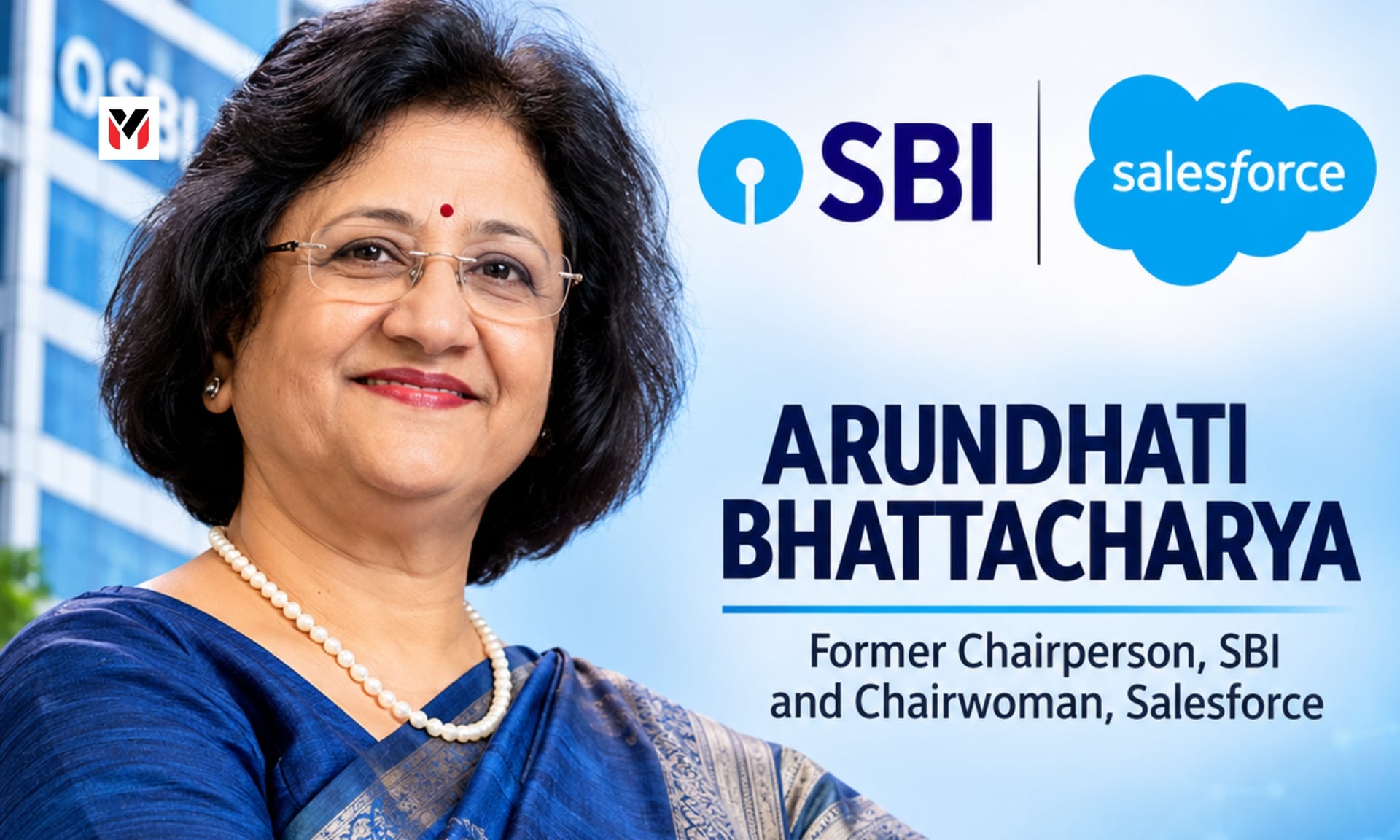
Arundhati Bhattacharya, former chairperson of SBI and chairperson/CEO of Salesforce India · Editorial · Independent profile preview.
From Literature Graduate to Probationary Officer
Arundhati Bhattacharya was born in Kolkata, and her father worked at the steel plant in Bhilai, where she spent her childhood. According to an Open magazine profile from December 2014, she majored in literature and could, by her own account, have become a professor of English, a museum curator or a food critic. In 1977 she passed the all-India probationary officers' examination, which led her to the State Bank of India.
Her first posting, she told Open, was to the busiest branch in West Bengal, a day before Durga Puja. She calls it "a total madhouse." She stayed for 36 years and, in that time, held more than a dozen jobs across retail banking, treasury, foreign exchange, human resources and investment banking. She led SBI Capital Markets, worked at the bank's New York office, and helped launch SBI General Insurance, SBI Custodial Services, SBI Pension Funds and the SBI Macquarie Infrastructure Fund. As a manager she introduced a two-year sabbatical policy that women employees could use for maternity or elder care.
Leading India's Largest Lender
She was managing director and chief financial officer before taking over as chairperson and managing director on 7 October 2013, the first woman to do so. She served until 6 October 2017. In late 2014, Open reported that SBI was the country's largest lender, holding about a quarter of all bank deposits and loans, with about US$380 billion in assets, roughly 220,000 employees and 15,000 branches. Women made up about a quarter of the workforce, with about ten in top-management posts. Gross bad assets had fallen from 5.64% of advances a year earlier to 4.89%, though she told the magazine she was "still not convinced this is the turnaround."
Her management style, as described by colleagues in the same piece, was participatory. One colleague said: "She likes discussion in the boardroom, so there is never a monologue." She solicited cost-cutting ideas from staff through a blog post, and one idea, switching off Mumbai's illuminated signs after 11 pm, was adopted. Asked about independence from the government, she said, "The Government does not tell us what to do." On leadership, her line was: "I have always believed that you should not make yourself indispensable."
“I have always believed that you should not make yourself indispensable.”
The Historic 2017 Associate Bank Merger
Her time as chair is tied to the largest consolidation in Indian banking. Five associate banks (Bikaner and Jaipur, Hyderabad, Mysore, Patiala and Travancore) and Bharatiya Mahila Bank merged into SBI, effective 1 April 2017. Her term, due to end in October 2016, was extended by a year, and coverage linked the extension to completing the merger. Today SBI's reference page describes assets of Rs 83.21 lakh crore as of 2026, and ranks it 43rd among the world's banks by assets; the page also gives conflicting customer and branch counts, so cite SBI directly for those.
Second Act: Salesforce India and Corporate Governance
The 2014 Open profile adds detail that a résumé does not. She once wanted a PhD in finance at IIT Kharagpur, under Professor Damodar Acharya, but dropped out when told she had to attend classes; she said she would still like to earn it. She lives in Mumbai, and listed yoga, theatre, reading, handcrafted saris and flea-market finds among her interests. She told the magazine, "Every day, I learn something new and it keeps me grounded." In the same piece, a chairman of a smaller bank said, "You can walk up to her and she will listen to your concerns no matter who you are."
She became an independent director on the board of Reliance Industries in October 2018 and is now a non-executive director there. In 2020 she was hired as chairperson and CEO of Salesforce India. She also chairs SWIFT India and the board of governors of IIM Sambalpur. Recognition includes Forbes' list of the world's most powerful women (25th in 2016), Foreign Policy's Global Thinkers (2016), the Asian Awards' Business Leader of the Year (2018), and, per the reference page, a Padma Shri in January 2025. Harvard Business Review published an interview with her in 2018, "The Making of SBI's First Woman Chairperson."
What readers can take from her path: 1. Long careers can compound. Moves across a dozen functions gave her a view of the whole bank. 2. Make practical policy. Sabbaticals for women employees are the kind of change that sticks. 3. Welcome argument in the room. A boardroom with debate catches mistakes earlier. 4. Do not make yourself indispensable. Succession starts with teaching others to do your job.
Independent editorial profile built from public sources. We have not interviewed Ms Bhattacharya.
- Open magazine, V. Shoba, 'The State Banker of India', updated 24 Dec 2014
- Wikipedia, 'Arundhati Bhattacharya' and 'State Bank of India'; Harvard Business Review, 2018 interview
The Editorial Desk
Perspectives on the people, ideas and businesses shaping what comes next. The articles in this preview are illustrative samples, not reported journalism.
More from the Editorial Desk