The Founder Who Never Raised a Round: Nithin Kamath and the Lean Business Behind Zerodha
A call-centre job, a sub-broker's desk and a flat fee per trade. The company he built with his brother has made billions in profit with fewer than 100 employees.
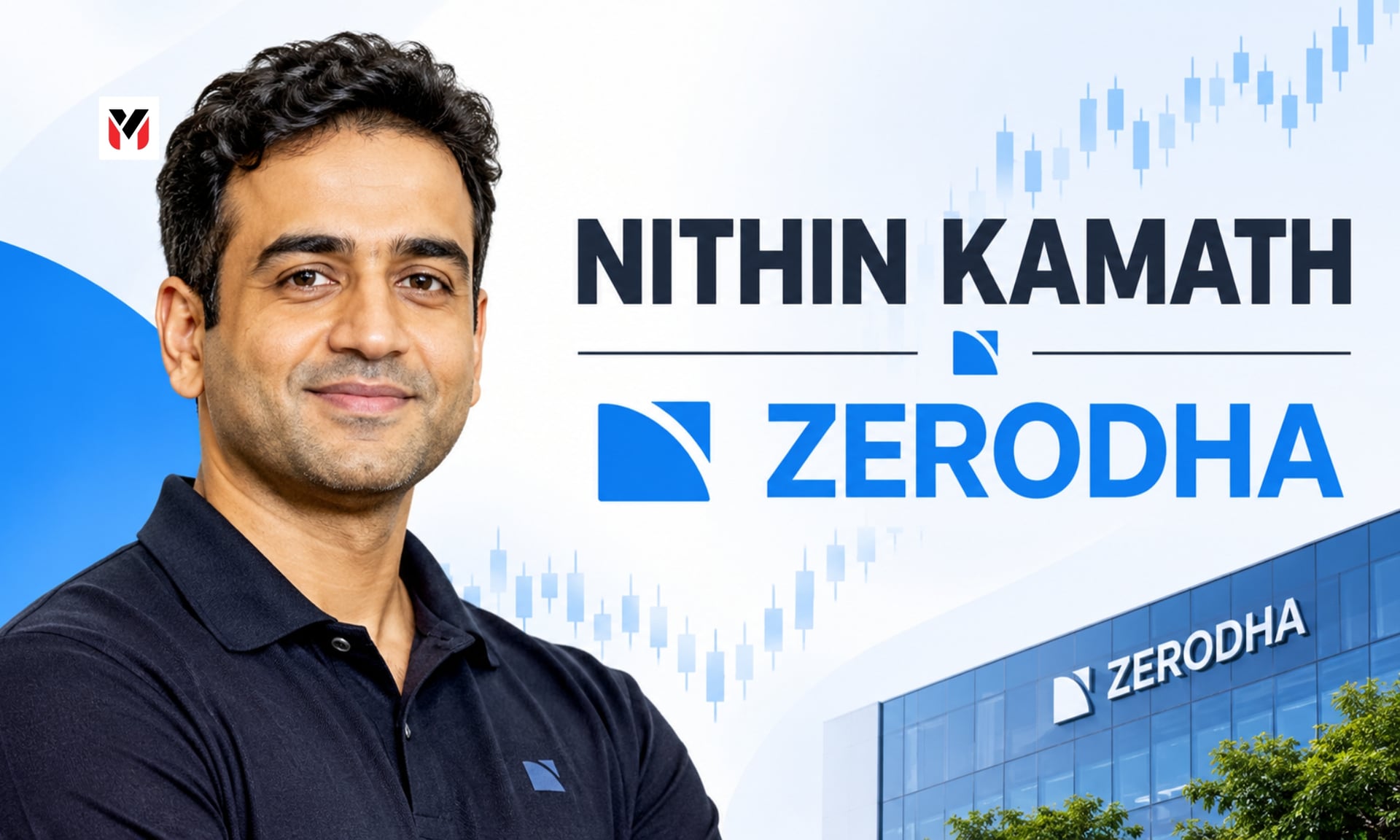
Nithin Kamath, co-founder and CEO of Zerodha · Editorial · Independent profile preview.
From Sub-Broker to Discount Broking Pioneer
Nithin Kamath was born on 5 October 1979 in Shivamogga, Karnataka, to a Konkani family. His father worked at Canara Bank, and his mother taught the veena. The family moved to Bangalore in 1996. He studied at the Bangalore Institute of Technology and began trading at 17, at first managing his father's account.
His early career was unglamorous. According to his reference biography, he was a self-employed trader from 1997 to 2004, worked as a tele-sales associate at a call centre from 2001 to 2004, and was a sub-broker for a Reliance Money franchise from 2004 to 2010. In 2010, with his brother Nikhil, he co-founded Zerodha.
The Flat-Fee Innovation and Organic Scale
The idea was simple: Zerodha introduced discount broking in India, with a flat fee of Rs 20 a trade regardless of order size. It grew by word of mouth and product quality, without significant advertising spend or venture capital. By 2020 it had a self-assessed valuation of about US$1 billion. In 2015 Kamath also founded Rainmatter, a fund and incubator for financial technology start-ups, and co-founded the investment firm True Beacon with his brother.
“Leverage gives you a boost when things are good. But when things go bad, they can get bad really, really quickly.”
The FY26 Numbers and Margin Dynamics
In August 2026, YourStory reported, based on Kamath's blog post marking Zerodha's 16th year, that profit for the year ended 31 March 2026 was Rs 4,283 crore, up about 1.2% from Rs 4,231 crore in FY25. Revenue was flat; FY25 revenue from operations was Rs 8,847 crore. The team is fewer than 100 people across technology, product, business and operations. Trading activity has cooled since the market peak in September 2024, and Kamath cited a Middle East energy crisis as another headwind.
Two details in the report are worth noting. The margin trading facility, where clients borrow to trade, has grown to about Rs 9,000 crore, of which clients borrowed Rs 6,000 crore, equal to 25% of Zerodha's net worth, and it produces about 10% of revenue. Account maintenance charges are about 2%. Kamath said futures and options trading is unprofitable for 99% of retail traders and that regulation is tightening. On leverage, his message was blunt: "Leverage gives you a boost when things are good. But when things go bad, they can get bad really, really quickly."
Hedging Market Cycles & Leadership Lessons
To reduce its reliance on a single line of business, Zerodha is expanding into Zerodha Capital, Zerodha AMC and the Rainmatter Foundation. Planned launches include US investing and mutual fund transactions inside the Kite platform. Its NRI business is growing, helped by simpler onboarding. Kamath also noted that broking lacks compounding because mandatory quarterly settlements return unused cash to banks, according to the YourStory report. Zerodha has also resumed paying a 10% referral commission.
Kamath's warning about leverage is a practical point for anyone who trades. Borrowing to buy shares magnifies gains and losses alike. The facility he describes lets a client borrow against holdings, so a fall in prices can force a sale at the worst moment. If you use it, know the margin level at which you would be asked to add cash, and keep a buffer. For futures and options, his figure that 99% of retail traders lose money is a reason to treat them as high-risk instruments, not as a source of regular income. This profile is not investment advice.
It is rare for the head of a very profitable financial company to warn customers about the products that earn it money. Kamath has done so repeatedly, and it is consistent with Zerodha's low-cost model: customers who stay solvent stay for years. Plenty of businesses chase growth; this one has chosen a narrower, steadier route.
What other founders can take from his story: 1. Start with what you know. A sub-broker's seat taught him the customer. 2. Say the uncomfortable thing. Telling clients about the risks builds long-term trust. 3. Keep the team small. Fewer than 100 people can run a business of this scale when software does the heavy work. 4. Diversify before you must. The new ventures are a hedge against a cooling market.
Independent editorial profile built from public sources. This is not investment advice. We have not interviewed Mr Kamath.
- Wikipedia, 'Nithin Kamath' (background, founding, Rainmatter)
- YourStory, 'Zerodha marks 16 years with steady profits', Aug 2026
The Editorial Desk
Perspectives on the people, ideas and businesses shaping what comes next. The articles in this preview are illustrative samples, not reported journalism.
More from the Editorial Desk