Several Ventures Before Lenskart: Peyush Bansal's Path From Failed Startups to a Listed Company
He started a college classifieds site, scrapped several ideas and then built India's best-known eyewear retailer.
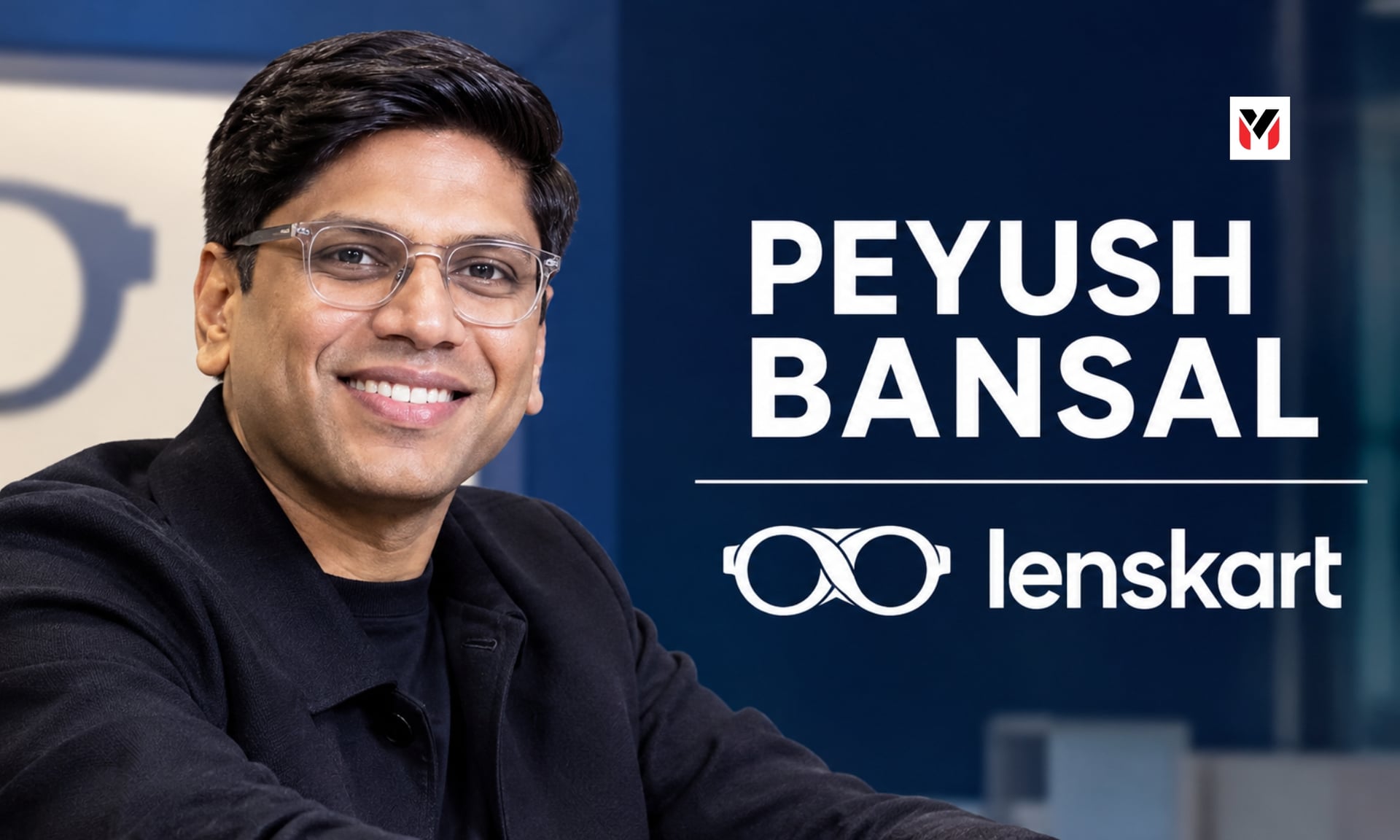
Peyush Bansal, founder, chairman and CEO of Lenskart · Editorial · Independent profile preview.
Early Experiments Under Valyoo Technologies
Peyush Bansal went to Don Bosco School in New Delhi and studied electrical engineering at McGill University in Montreal. He later completed a management programme for entrepreneurs and family businesses at IIM Bangalore. In 2007 he came back to India and started SearchMyCampus.com, a classifieds site for college students. In 2008 he registered Valyoo Technologies, the parent company under which several short-lived ventures followed, among them Flyrr, scrapped in November 2010.
Lenskart began in 2010 as an online eyewear store under Valyoo Technologies, with co-founder Amit Chaudhary. Sumeet Kapahi joined in 2011. The company is based in Gurugram. Bansal is chairman, managing director and chief executive, and also appears as a judge on Shark Tank India.
Why Eyewear: Owning the Entire Chain
India has a very large population that needs vision correction, and many people go years without a proper eye test. That gap between need and access is the market Lenskart is chasing. Eyewear is a business with two unusual features: most customers need it, and most customers dislike the process of getting it. Prescription glasses require an eye test, a frame choice and a fitting. Lenskart's bet was to control the whole chain: frames, lenses, stores and delivery. That means owning more of the cost and more of the problem.
“Eyewear is a business where most people need the product and dislike the process.”
The Rs 7,278-Crore November 2025 Public Offering
Lenskart's public offering was open from 31 October to 4 November 2025, with a price band of Rs 382-402 a share. Business Standard reported that it was subscribed 28.26 times and that the issue price was Rs 402. The shares debuted on 10 November at Rs 390, a 2.99% discount to the issue price, before trading briefly around Rs 404.80 on the BSE that morning. The headline called it a "muted debut despite robust IPO demand."
The offer combined a fresh issue of up to Rs 2,150 crore with an offer for sale of 12,75,62,573 shares worth up to Rs 5,128.02 crore, sold by existing shareholders including Peyush Bansal, Neha Bansal, Amit Chaudhary and Sumeet Kapahi. Anchor investors put in Rs 3,268.35 crore through 147 investors.
The company's stated plans for the fresh issue give a clear picture of the business: Rs 272.62 crore for new company-owned store openings, Rs 591.44 crore for store lease and rent payments, Rs 213.37 crore for technology and cloud infrastructure, Rs 320 crore for brand marketing, and the rest for acquisitions and general corporate purposes. Promoters held 19.9% of pre-offer equity, expected to fall to about 17.72% after the IPO. In the first quarter of FY2026, Lenskart reported consolidated net profit of Rs 76.42 crore on sales of Rs 2,032.25 crore.
What Changes After a Listing & Founder Lessons
Going public changes the daily life of a founder-led company. Results are published every quarter, and every number is compared with expectations. A retailer that is opening stores, paying rent and spending on marketing will show those costs in public, and shareholders will judge whether each new store earns its keep. For Lenskart, the disclosed plan to spend on company-owned stores, rent, technology and brand marketing gives investors a list of things to track: store openings, profit per store, technology spending and customer acquisition cost. Readers who follow the stock should watch those items in the quarterly reports, rather than the day-to-day share price.
The listing price tells us something about how investors weighed the story. Demand for the offering was strong, yet the stock opened at a small discount, which suggests that some buyers wanted allotment and did not expect a big first-day jump. We should avoid reading too much into one morning's trading. What stands out is how much of the new money is being spent on stores and rent, which shows that physical retail remains central to the model.
What other founders can take from his story: 1. Ventures that fail still count. The earlier ideas that were scrapped gave him practice in building teams and products, and in knowing when to stop. 2. Own the hard part. Lenskart's strength is its control of the whole chain. 3. Plan for the listing years ahead. The use-of-proceeds disclosure forces clarity about where growth will come from. 4. Founders can sell and still lead. Promoters sold shares in the offer and remain in charge.
Independent editorial profile built from public sources. We have not interviewed Mr Bansal.
- Wikipedia, 'Peyush Bansal' (education, early ventures)
- Business Standard, 'Lenskart Solutions makes muted debut despite robust IPO demand', 10 Nov 2025
- Note: the Wikipedia article's description of the total IPO size was inconsistent; we use Business Standard's breakdown (Rs 2,150 crore fresh issue plus up to Rs 5,128.02 crore offer for sale).
The Editorial Desk
Perspectives on the people, ideas and businesses shaping what comes next. The articles in this preview are illustrative samples, not reported journalism.
More from the Editorial Desk