Whiteboard, Smartphone, Revolution: How Alakh Pandey Built PhysicsWallah on Radical Affordability and Pure Trust
While hyper-funded edtech competitors burned through billions on high-pressure sales calls and celebrity brand ambassadors, a teacher in Prayagraj focused on making physics crystal-clear for ₹3,000 a year. Today, Alakh Pandey's company stands as the most resilient educational enterprise in India.
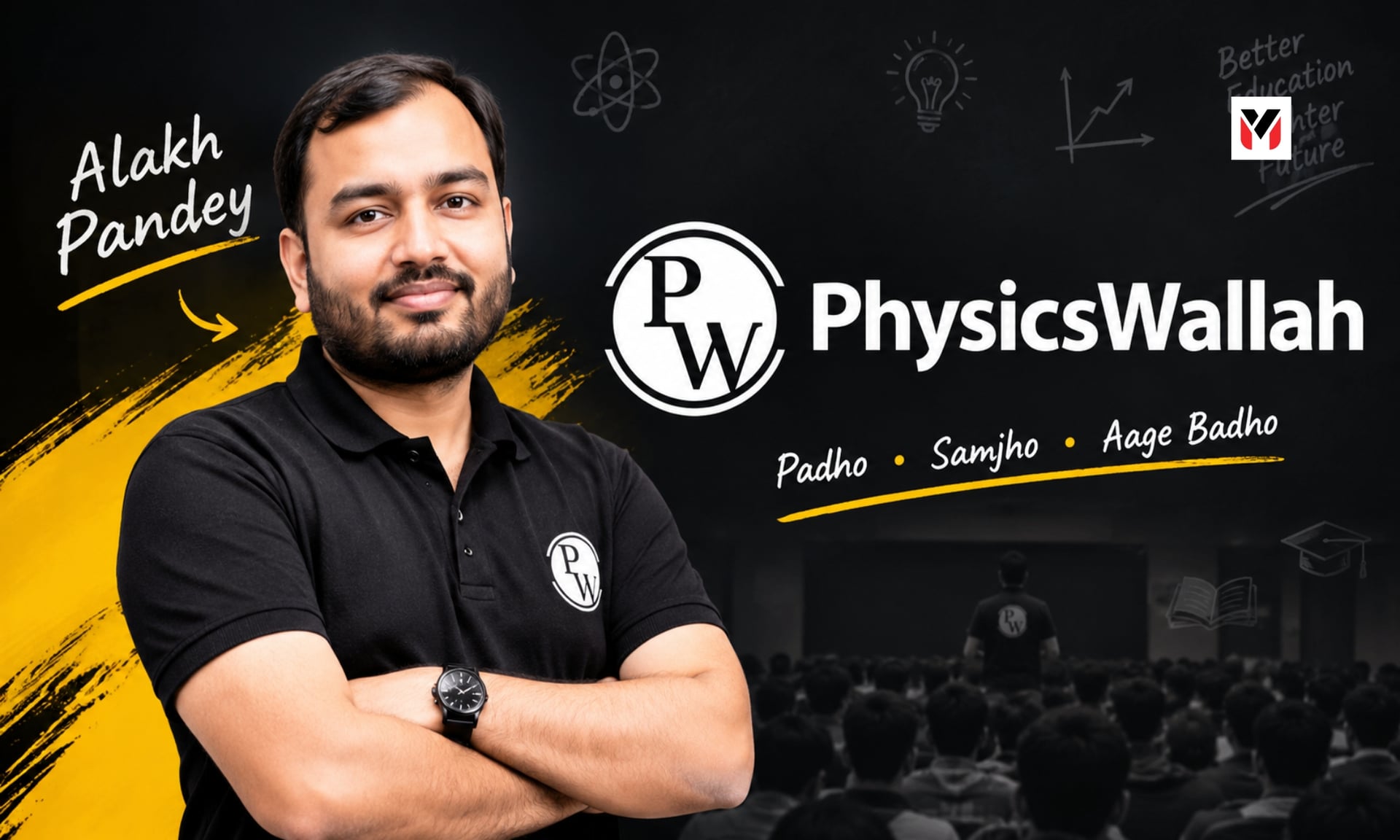
Alakh Pandey, founder of PhysicsWallah, with the PW logo and an auditorium of students · Editorial · Analysis preview.
The Prayagraj roots and the rejection of mega-offers
Alakh Pandey's family had faced intense financial hardships during his youth, forcing them to sell their ancestral home. To support his family, Pandey began tutoring younger school students while still in the eighth standard. Teaching was not a corporate pivot; it was a life raft.
By 2019, as his YouTube subscriber count crossed millions, rival edtech giants attempted to recruit him. Legend has it that one company offered Pandey an annual package exceeding ₹40 crore, followed by equity checks, on the condition that he shut down his YouTube channel. Pandey flatly refused, asking: 'If I leave my students for money, who will teach the rickshaw puller's son who watches my lectures at night?'
The partnership with Prateek Maheshwari
While Alakh Pandey was a phenomenal pedagogue who commanded cult-like devotion from students, he needed an operational architect to build an enterprise. In 2020, he partnered with IIT Varanasi alumnus Prateek Maheshwari.
Maheshwari brought technology leadership, scalable video-streaming infrastructure, and financial discipline. When they launched the PW app in May 2020, the server crashed within minutes as over 100,000 students rushed to purchase the ₹3,500 'Lakshya' batch. Maheshwari stabilized the platform, established automated doubt-solving forums, and engineered low-latency streaming that worked on slow mobile data connections.
“Edtech is not software; it is emotion. You cannot sell education through guilt. You earn the right to teach when a student knows you care whether they pass.”
Radical pricing as an unassailable moat
Legacy coaching institutes in Kota and venture-backed apps operated on high ticket sizes and massive customer acquisition costs (CAC). They spent up to 50% of their revenue on marketing, forcing them to raise course prices to survive.
PhysicsWallah turned this equation on its head. With zero marketing spend and near-zero CAC driven by Pandey's organic YouTube reach, PW could price high-quality comprehensive courses at ₹3,000 to ₹4,000. For an ordinary middle-class Indian family, paying ₹300 a month for expert coaching was a trivial decision. Competitors could not match PW's pricing without destroying their own gross margins.
The offline expansion: Vidyapeeth and hybrid scale
When the COVID-19 pandemic waned and students returned to physical classrooms, many purely digital edtech platforms saw user engagement collapse. Pandey and Maheshwari moved decisively into hybrid education, opening 'PW Vidyapeeth' centres in tier-1, tier-2, and tier-3 cities.
Rather than building opulent corporate centres, PW Vidyapeeth focused on high-discipline study environments, tech-enabled live lectures by Kota's top faculty, and local teaching assistants for doubt resolution. By pricing offline batches at one-third the fee of Kota's legacy incumbents, PW quickly filled hundreds of classrooms with hundreds of thousands of enrolled students.
Lessons for mission-driven entrepreneurs
• Empathy is the ultimate marketing strategy: When your customers genuinely believe you want them to succeed, you never have to convince them to buy. • Maintain unit discipline: Scale should reduce your cost per student, not increase your overhead. Frugality protects pedagogical independence. • Never sell through shame: Education is an instrument of social mobility, not fear. Products that inspire students will always outlast those that exploit parental anxiety.
The enduring revolution
In an industry scarred by governance scandals, predatory loans, and multi-thousand-crore bankruptcies, PhysicsWallah proved that an Indian educational institution can be honest, profitable, and profoundly transformative. Alakh Pandey's journey from a chalkboard in Prayagraj to an edtech titan remains a masterclass in student trust and purpose-driven building.
- PhysicsWallah (PW) corporate announcements and Q1 FY27 financial reports, August 2026.
- YourStory and Inc42 reporting on PW Vidyapeeth offline expansion and student enrollments.
- Ministry of Corporate Affairs filings for Physicswallah Private Limited, FY23–FY26.
The Editorial Desk
Perspectives on the people, ideas and businesses shaping what comes next. The articles in this preview are illustrative samples, not reported journalism.
More from the Editorial Desk