One Platform, Many Prices: The Product Thinking Behind Ather's Konarc
Ather's first mass-market scooter launched below the price many reviewers expected. The way it was designed and sold is a lesson in platform thinking.
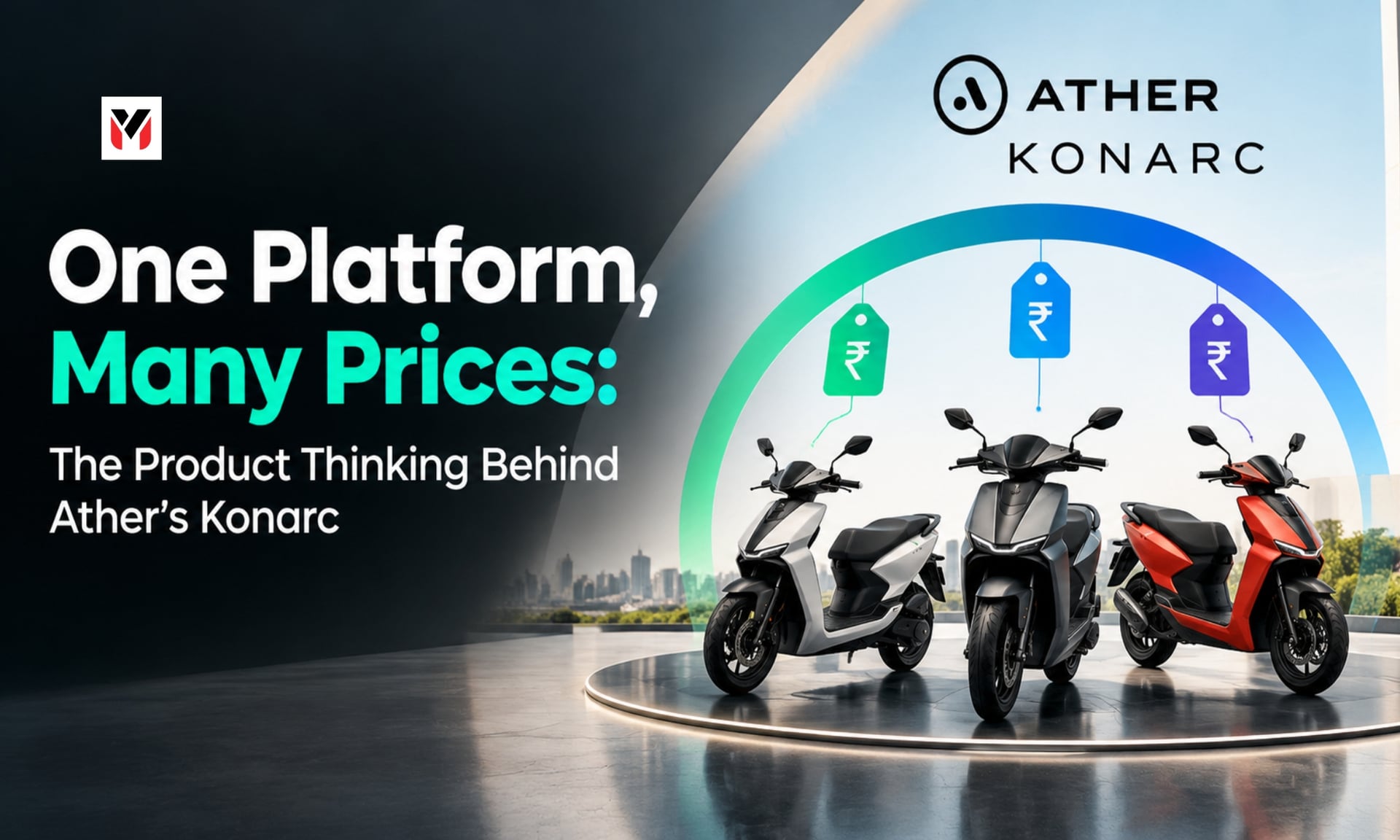
Three scooters of different sizes sharing one underlying frame outline · Editorial · Analysis preview.
Headline and Overview
Ather Energy launched the Konarc electric scooter on 29 August 2026, according to Times Drive. The scooter is built on Ather's EL platform. Ex-showroom prices were Rs 99,999 for the S 100km variant, Rs 1,21,999 for the S 125km and Rs 1,44,999 for the S 161km, with a 200km S variant planned and the prices of two Z-Line variants not yet announced. The article called Rs 99,999 a "starting price" and did not say whether it was introductory.
What was confirmed
The batteries are 2.1 kWh for 100 km, 2.7 kWh for 125 km and 3.5 kWh for 161 km (claimed ranges). Features include a 4.2-inch display or a 7-inch screen depending on the variant, smartphone connectivity, turn-by-turn navigation, AutoHold, FallSafe and the MagicKey keyless system. The article listed a 450W onboard charger with a charge time of 4 to 5 hours 40 minutes for 0-80%, depending on variant, a peak of 4.7 kW and 16 Nm, and a claimed top speed of 70 km/h for S-Line variants. Deliveries are staggered: the S 125km and S 161km from September 2026, the S 100km in the first quarter of 2027, the Z-Line variants in the second quarter of 2027 and the S 200km in the third quarter of 2027.
Before the launch, GaadiFy had reported that the scooter would be based on the EL01 concept, that the EL platform was developed using 26 lakh km of field data and could support battery packs from 2 kWh to 5 kWh, and that the writer expected a price of Rs 1 to 1.25 lakh. That prediction was labelled as unconfirmed in the article. The actual entry price came in just below it.
“A good platform lets a company sell different prices without redesigning the machine.”
Why this is a product-strategy story: our analysis
1. A platform, not a product. A single underlying design that supports battery sizes from 2 to 5 kWh lets one company offer several prices without redesigning the vehicle. This is the core economic idea of a platform: share the expensive parts, vary the visible ones.
2. A price ladder. Three variants span roughly Rs 45,000 from the lowest to the highest price. A ladder lets a buyer trade up for range and gives the company a way to learn which level customers prefer.
3. Entry price as a message. A sub-Rs 1 lakh headline price puts the product into a new bracket in buyers' minds, even if most buyers choose a higher variant. Whether Ather intends that, the article did not say.
4. Staggered deliveries manage risk. Delivering the middle and top variants first, and the entry variant months later, gives the company time to ramp production. The trade-off is that the cheapest headline product is the last to reach customers. Buyers have to wait, which tests loyalty.
5. Data as a design input. The company's reference to field data from earlier scooters is a reminder that products improve when companies learn from use.
What the sources do not say
They do not report bookings, production volumes, costs or margins on the Konarc. They do not say how the new scooter affects sales of existing models. We cannot tell whether the entry price is sustainable. A careful reader should treat the launch as a statement of intent, not evidence of success.
Risks
A cheaper product can cannibalise sales of a company's higher-priced range. The market is competitive, and rivals can respond on price. Delivery delays of many months can cause cancellations. And a low entry price depends on supply chain costs, especially batteries, staying under control.
Lessons for founders
• Design a platform when you expect a family of products. Do it only if the shared parts truly cut cost. • Test your ladder. Offer options at different prices and watch which sells. • Be careful with launch dates. If part of the range cannot ship for months, say so clearly. • Use customer data. Real-world use is the best source of improvement.
For suppliers
A platform that spans several battery sizes and variants means demand for a wide range of components over a longer period. Suppliers who can scale volumes up and down will benefit, a point relevant to the clusters we describe in our Enterprise coverage.
- Times Drive, 'Ather Konarc Electric Scooter Launched in India at Rs 99,999 with 161km Claimed Range', 29 Aug 2026
- GaadiFy, 'Ather's EL01-based family scooter to be named Konarc, launch on August 29', 10 Aug 2026
- Editorial analysis. Specifications and prices as reported by Times Drive (29 Aug 2026) and GaadiFy (10 Aug 2026); expected items are labelled as such.
The Editorial Desk
Perspectives on the people, ideas and businesses shaping what comes next. The articles in this preview are illustrative samples, not reported journalism.
More from the Editorial Desk