The Retailer Builds the Gadget: Lenskart's Bet on Smart Glasses
Lenskart says it can compete with global smart-glasses makers because it owns the stores where people buy and fit glasses.
A pair of smart glasses in front of a map dotted with store locations · Editorial · Analysis preview.
Headline and Overview
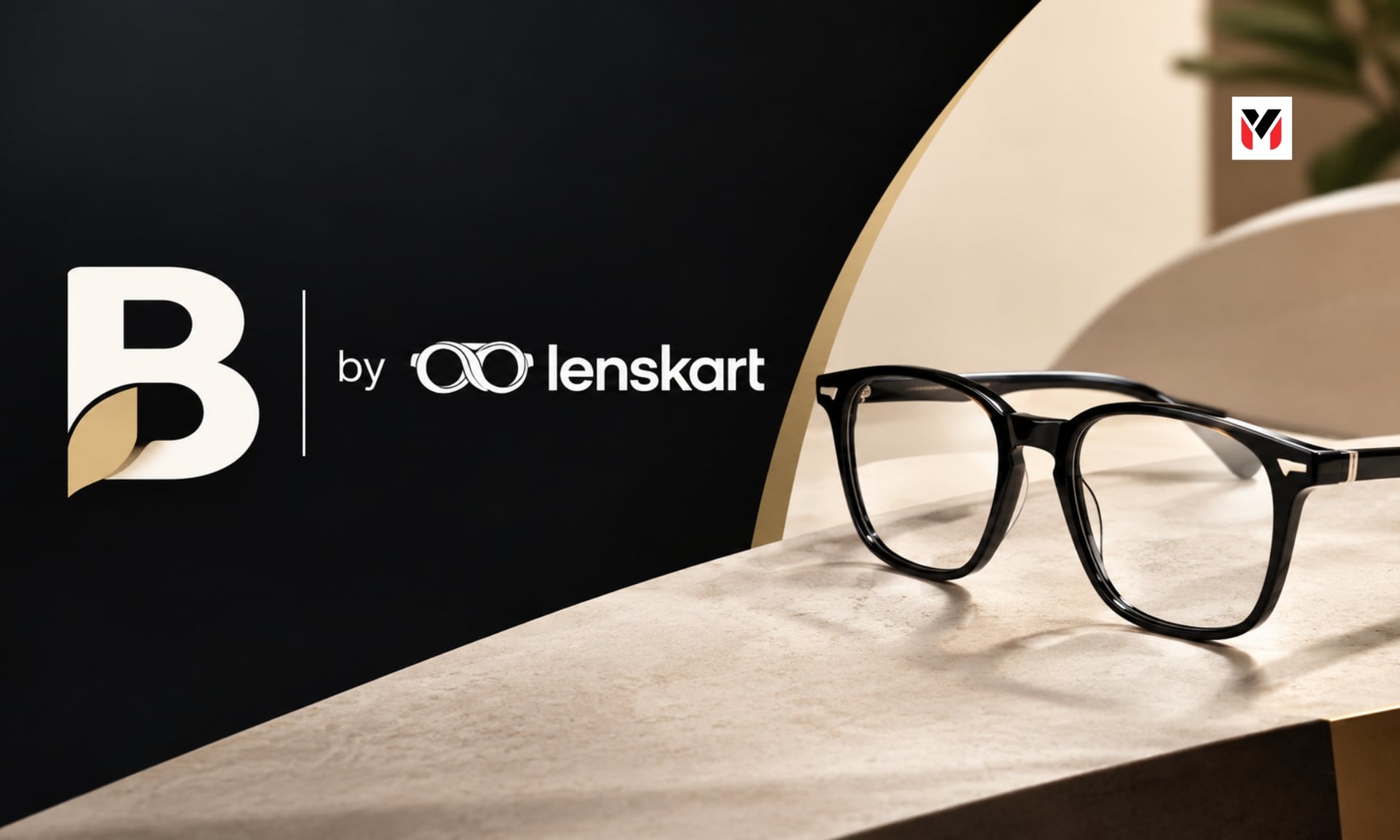
Medianama reported in February 2026 that Lenskart planned to soft-launch AI-enabled smart glasses, named "B by Lenskart", in the quarter ending March 2026. Lenskart had first announced them in the second quarter of FY26. The article gave no price. Features it listed were integration with Google's Gemini Live, photo and video capture, meal logging and chat with Gemini Live, with software and firmware updates to follow based on user feedback.
The strategic argument
The most interesting content in the article was a claim about distribution. Referring to Meta, which sells Ray-Ban and Oakley smart glasses and whose chief executive said on the fourth-quarter 2025 earnings call that smart-glasses sales had more than tripled over the past year, Lenskart chief executive Peyush Bansal said: "Meta doesn't have 3,000 stores where you can try, fit, get a service, get a prescription." He added: "We own the full pipe here."
Lenskart described its footprint as 3,000-plus stores, 20 million annual customers and the largest optometry network in its markets, and said it captures more than 100,000 face scans daily "with user consent". The article did not say what share come from India. It reported that remote eye testing had expanded to 369 stores in December 2025 from 168 in March 2025, that eye tests for children over eight began across Indian stores in January 2026, and that self-service kiosks and mobile eye-testing units were in development.
“We own the full pipe here.”
The results behind the strategy
For the third quarter of FY26, the article gave operating revenue of Rs 2,307.7 crore, up 37.4%, and net profit of Rs 132.7 crore, up 238% from Rs 39.3 crore. It reported 6.3 million eye tests globally (5.5 million in India, 49% of them first-time exams) and 8.9 million eyewear units sold, up 29.7%. The article gave two different figures for new stores in the quarter, 169 and 195, without explaining the discrepancy. Lenskart also announced a $186 million purchase of a 29.2% stake in South Korea's iNeer, for AI eye-testing and lens-edging equipment, and a $5 million joint venture with Marco Optical and Sunrise Matt Optical.
Product lessons: our analysis
1. Distribution can beat features. A product that people try, fit and have serviced in a store is easier to sell than one bought online. For wearables, fit and comfort matter, so the physical network is a real asset.
2. Borrow the hard part. Using Google's Gemini Live for the AI means Lenskart need not build the model. It can focus on hardware, fit and service. The risk is dependence on a partner.
3. Soft launches limit risk. A small initial release lets a company fix problems before a wide rollout, particularly for a first-generation device.
4. Existing customers are the first market. With millions of annual customers, the company has an audience to test with and learn from.
5. Services extend the product. Updates after launch, as described in the article, mean the product will change over time. Buyers should know what support to expect.
Questions we would ask the company
What does it cost, and how does that compare with global options? What data do the glasses collect, where is it stored and who can access it? What is the battery life? How are prescription lenses handled? What happens to the product if the AI partner changes its terms? Camera glasses raise questions about the privacy of people nearby, and we have not seen the company's policy.
Risks
First-generation wearables often disappoint on battery life, comfort and usefulness. The market may be small. Privacy concerns about cameras on faces could limit adoption. And the article reported plans and claims, not sales; we cannot say how many units have sold.
For founders
If you have a distribution network, ask what products it could carry that competitors cannot easily reach. If you have a product, ask who already owns your customers' trust and whether you can partner with them.
How to judge the bet
Three tests will tell whether this works. First, do buyers return for adjustments and servicing, which is where a store network earns its keep? Second, do the glasses become something people wear daily, or a novelty kept in a drawer? Third, does the partnership with a larger AI provider remain stable on cost and terms? None of these can be answered from launch-stage reporting, so readers should treat the strategy as a hypothesis to watch rather than a result.
- Medianama, 'Lenskart to launch AI smart glasses; Meta lacks 3,000 stores: earnings', February 2026
- Editorial analysis based on one Medianama report (February 2026); company claims are labelled as such.
The Editorial Desk
Perspectives on the people, ideas and businesses shaping what comes next. The articles in this preview are illustrative samples, not reported journalism.
More from the Editorial Desk