A Carbon Price at the Border: How Exporters Should Prepare for CBAM
From 2026, the EU's carbon border mechanism begins to price the emissions in imported steel, aluminium and other goods. Indian exporters are among those exposed.
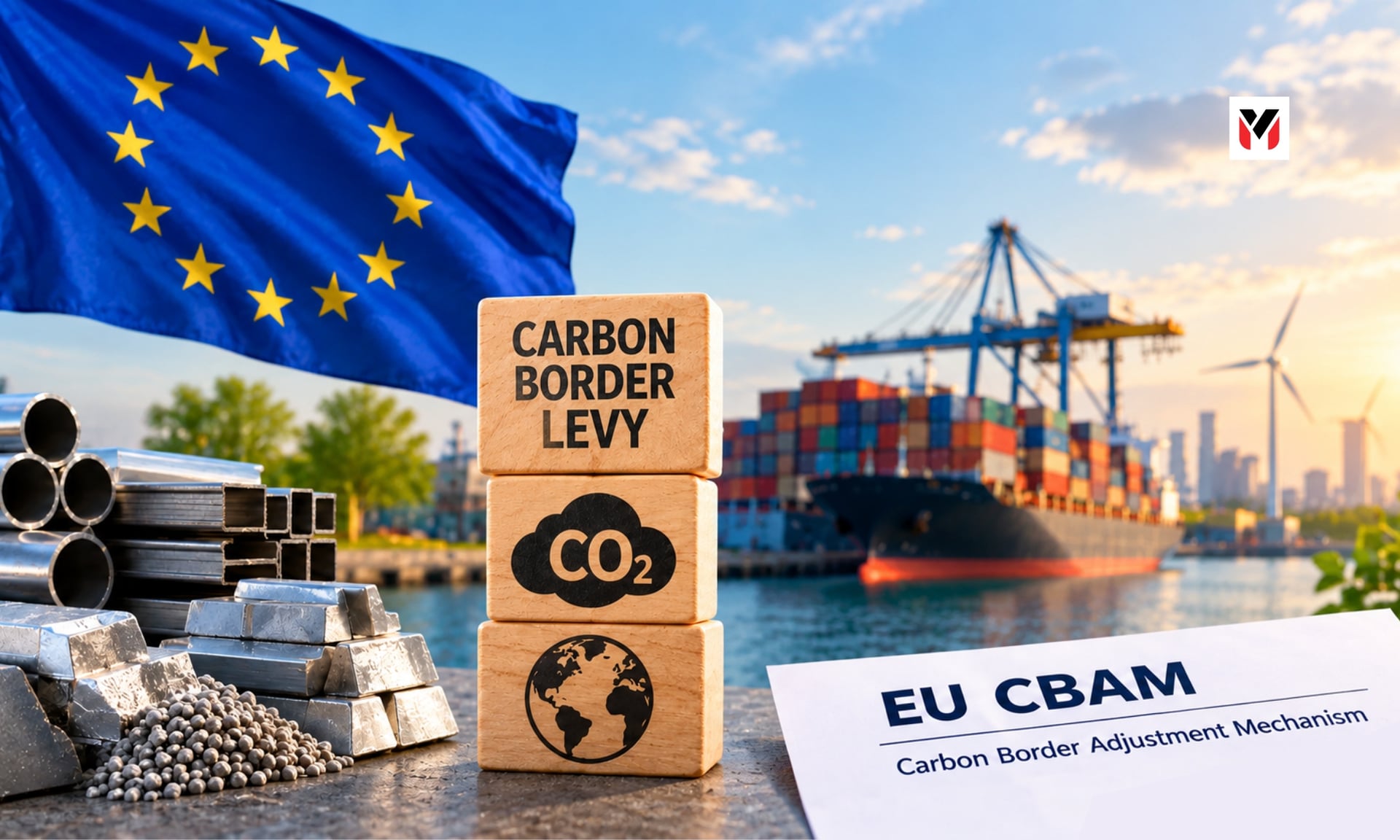
A cargo container at a border gate with a carbon-price tag · Editorial · Analysis preview.
Headline and Overview
The European Union's Carbon Border Adjustment Mechanism (CBAM) is designed to charge importers for the carbon emitted in making certain goods, so that European producers, who pay a carbon price, are not undercut. A Policy Circle opinion article by Mumbai-based corporate economist Prachi Priya, published in March 2024, set out the timeline: a reporting-only transition period from October 2023 to December 2025, the start of the levy in January 2026, and a gradual phase-out of free allowances over eight years ending in 2034. The covered sectors, it said, are cement, iron and steel, aluminium, fertilisers, electricity and hydrogen.
Please note the limits of our source. It is an opinion piece from 2024, not an official document, and rules and prices may have changed. We recommend checking the European Commission's current guidance and getting professional advice before acting on any figure here.
How exposed is India?
The article estimated that the six covered sectors make up about 12% of India's exports to the EU, around $8.5 billion. It said 27% of India's aluminium exports ($2.7 billion) and 38% of its steel exports ($3.7 billion) go to the EU. It estimated the levy under the then-current scope at 7 to 15% ad valorem, calculated as emissions above the EU's free allowance multiplied by the EU carbon price, which the article put near $100. It added that electricity-related (Scope 2) emissions were not then included, and that if they were added after the free allowances are phased out, the impact could reach 25 to 50%. These are the author's estimates and depend on assumptions about prices and scope.
“The border now has a carbon price; the question is who pays it.”
What the numbers do and do not tell us
They suggest that the exposure is concentrated: two metals account for most of the affected exports. They do not tell us how many companies are involved, how their emissions compare with EU producers, or how much of the cost would be passed to buyers. A firm's own cost depends on how carbon-intensive its production is and how well it can document that.
Our analysis: a checklist for exporters
1. Find out if you are covered. Check your product codes against the CBAM list, including downstream products that use covered materials. Your European buyer may already have asked. 2. Measure embedded emissions. You need figures per tonne of product, calculated using the EU's methods. If you cannot show them, default values may apply, and these are usually less favourable. 3. Check your power source. Electricity is a major emissions input for aluminium and steel. A move to renewable power can lower your embedded emissions, as our piece on India's renewable capacity discusses. 4. Talk to your buyers. Ask how they plan to share the cost and what data they need from you. 5. Consider India's own carbon price. The domestic carbon market we cover in a companion piece may become relevant to how Europe treats carbon already paid in India. We do not know how that will be decided and would not rely on it. 6. Diversify. Do not assume the EU market will stay as profitable for carbon-intensive goods. Look at alternative markets and at higher-value products.
For MSMEs and balanced perspective
Many MSMEs supply parts and castings to larger exporters. If your customer exports to the EU, expect requests for emissions data about your processes. Preparing a simple record of energy use, fuel type and output now will make those requests easier to answer.
Some analysts see CBAM as a trade barrier; others see it as an incentive to decarbonise. Both views are held in good faith. For an individual company the practical question is the same: what will it cost, and what can we do about it?
What a prudent exporter does this quarter
Call your main European buyer and ask three direct questions: are my products covered, what emissions data do you need, and in what format? Then ask your own team who can produce that data and how long it will take. Finally, ask your adviser what default values the EU uses if you cannot supply your own, because those defaults set the worst case you are trying to avoid. Writing down the answers gives you a plan and a budget, which is more useful than reading further commentary on the policy.
Editorial analysis based on a 2024 opinion article; verify current rules, prices and scope.
- Policy Circle, 'Decoding CBAM: How will EU's carbon levy impact India', Prachi Priya (opinion), March 2024
The Editorial Desk
Perspectives on the people, ideas and businesses shaping what comes next. The articles in this preview are illustrative samples, not reported journalism.
More from the Editorial Desk