From ISRO to Orbit: How Pawan Kumar Chandana Built Skyroot Aerospace into India's Private Space Pioneer
When Vikram-S soared into the upper atmosphere, it marked India's arrival in the global commercial spacetech race. Co-founder Pawan Kumar Chandana explains how frugality, additive manufacturing, and deep engineering turned an audacious thesis into flight hardware.
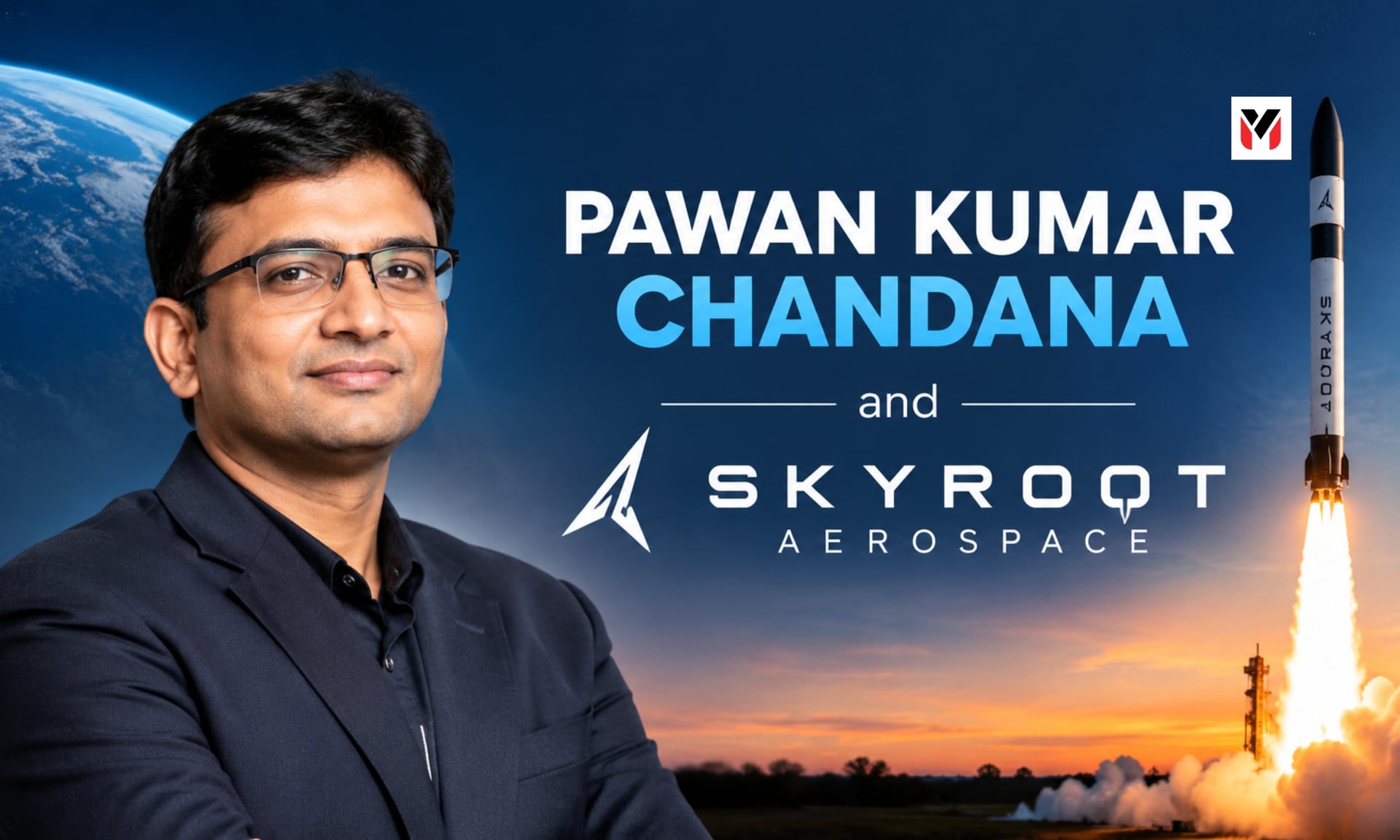
Pawan Kumar Chandana, co-founder and CEO of Skyroot Aerospace, with the Vikram launch vehicle soaring into the sky · Editorial · Analysis preview.
The leap from Sriharikota to an empty garage
Leaving the Vikram Sarabhai Space Centre is not a conventional career move in Indian engineering. For six years, Pawan Kumar Chandana worked on structural analysis and design for ISRO's workhorse PSLV. He had job security, national purpose, and access to world-class testing infrastructure. Yet in 2018, Chandana and fellow ISRO engineer Naga Bharath Daka walked away.
Their conviction was simple: the global small-satellite market was exploding, but launch availability remained an expensive bottleneck. Ridesharing on giant rockets meant small constellation operators had to wait eighteen months and compromise on orbital inclination. What the world needed was dedicated, responsive micro-launchers—and India possessed the rare supply chain and talent base to build them at unprecedented cost efficiency.
The engineering architecture: 3D printing and composites
Building a rocket company with tens of millions of dollars instead of billions requires radical architectural choices. Chandana refused to replicate legacy manufacturing methods that rely on months of bespoke tooling, casting, and hand-welding.
Skyroot pivoted to additive manufacturing from day one. Their Dhawan series cryogenic upper-stage engine—fuelled by liquid natural gas (LNG) and liquid oxygen (LoX)—is 3D-printed in single pieces using selective laser melting of specialized superalloys. This eliminated hundreds of joints, failure points, and assembly hours. Simultaneously, Skyroot developed proprietary carbon-fibre winding techniques for solid rocket motor cases, ensuring featherweight airframes capable of surviving brutal aerodynamic pressures.
“In aerospace, capital efficiency is not about cutting corners; it is about choosing architectures that forgive small errors and reward rapid iteration.”
Prarambh: The day the thesis fired
When Mission Prarambh ignited on the sounding rocket launchpad at Sriharikota in November 2022, the stakes could not have been higher. A launch failure would have dampened investor enthusiasm for the entire fledgling Indian spacetech sector.
Vikram-S achieved an altitude of 89.5 kilometres, executed all planned aerodynamic manoeuvres, and validated 90% of the core avionics and propulsion systems intended for orbital flight. For Chandana, it was validation not just of propulsion chemistry, but of team culture: fifty young engineers had delivered an orbital-class vehicle prototype in record time.
The capital efficiency paradox
"Space is hard, but wasteful space is unforgivable," Chandana has often observed. While American counterparts routinely burned $150 million to reach a test launch, Skyroot achieved its sub-orbital milestone on under $20 million in invested capital.
This frugality was achieved not by depressing safety margins, but by leveraging India's tier-1 precision machining clusters in Hyderabad, Bengaluru, and Pune. By treating local industrial suppliers as strategic development partners rather than mere contract vendors, Skyroot created a domestic aerospace ecosystem.
Lessons for deep-tech founders
1. Respect physics over software metaphors: Unlike code, hardware cannot be patched after deployment. Iterative testing must be rooted in exhaustive simulation and rigorous environmental stress tests. 2. Leverage national infrastructure: Without the testing benches and safety protocols provided by ISRO and facilitated by IN-SPACe, private spaceflight in India would have remained a dream. Great founders build bridges with statutory institutions. 3. Talent over pedigree: Skyroot hired engineers from tier-2 colleges across Andhra Pradesh, Telangana, and Tamil Nadu who possessed grit and mechanical intuition rather than corporate complacency.
The horizon ahead
With Vikram-I slated for commercial orbital insertion missions, Skyroot is transitioning from an engineering pioneer to a commercial launch provider. For Indian founders watching Chandana, the message is unequivocal: deep tech from India is no longer an aspirational slogan; it is a proven commercial reality.
- IN-SPACe mission approvals and launch telemetry, Vikram-S mission 'Prarambh', Nov 2022.
- Skyroot Aerospace technical announcements and patent disclosures on Dhawan cryogenic engine series.
- ISRO public private partnership policy documentation, 2020–2026.
The Editorial Desk
Perspectives on the people, ideas and businesses shaping what comes next. The articles in this preview are illustrative samples, not reported journalism.
More from the Editorial Desk