Charging the Driver a Fee, Not a Cut: Rapido's Bet on a Different Model
Rapido began with bike taxis and now covers autos, cabs, parcels, food and travel. Its drivers pay a daily fee instead of a commission.
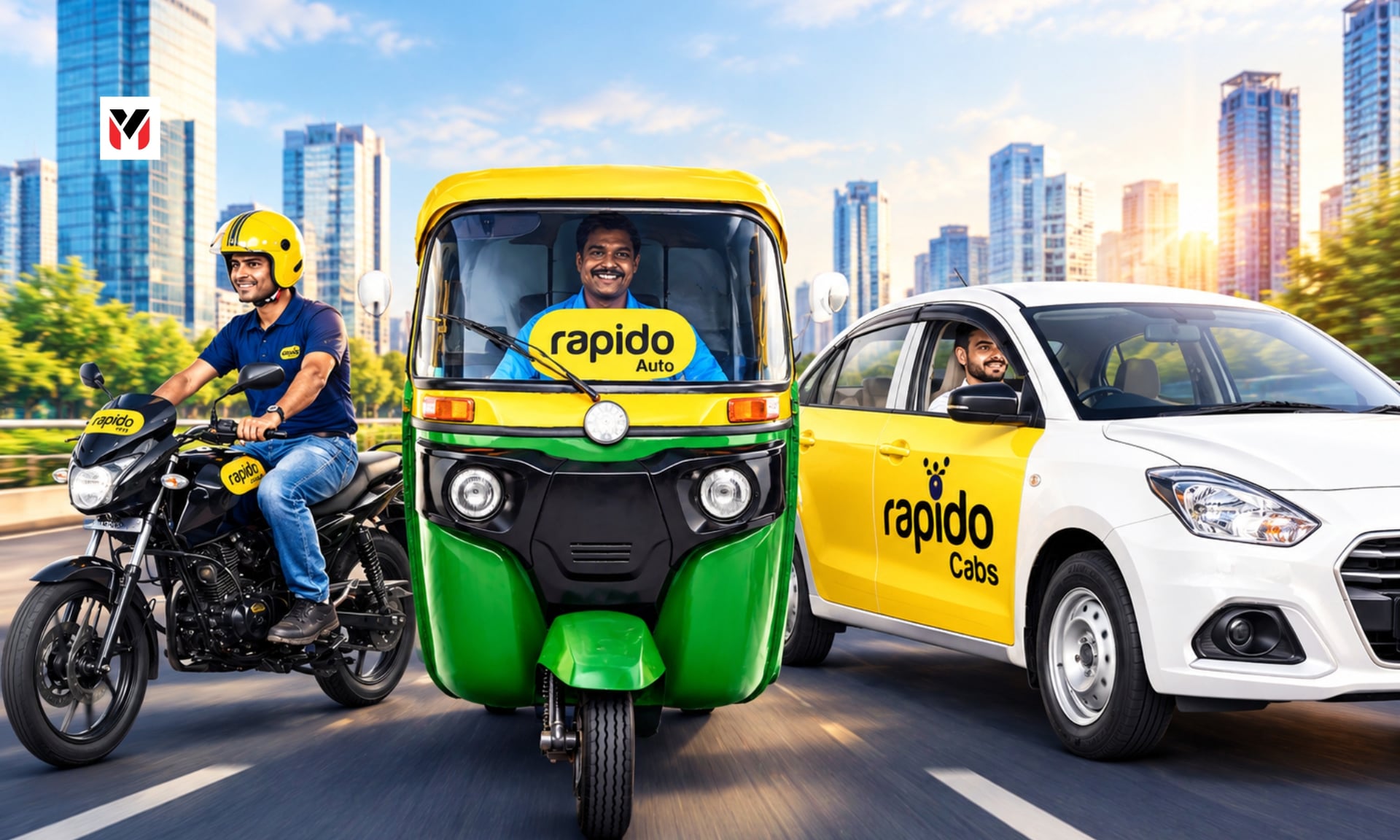
A three-wheeler auto, motorcycle, and taxi converging on a smartphone app interface · Editorial · Analysis preview.
Headline and Overview
An Inc42 feature on Rapido's super-app model laid out how the company works. It began with a commission model, taking a share of each fare. Its cab service (launched in 2023) and auto service (2024) were introduced with zero commission, with drivers paying a daily fee for unlimited rides. Inc42 reported that Uber introduced a SaaS-based zero-commission model in February 2025 and Ola followed with a subscription, so the approach is now common across the category.
Beyond rides
The segments, per the article, include bike taxis, autos and cabs; parcel and hyperlocal delivery, which began as Rapido Local in 2020 and now serves Swiggy, Zomato, e-commerce, quick-commerce and ONDC; food delivery through Ownly, piloted in Bengaluru in 2025; travel bookings added in October 2025 through partnerships with Goibibo, redBus and ConfirmTkt; and advertising on its consumer and driver apps. Ownly changed its model more than once: in August 2025 it charged a Rs 25 restaurant fee per order plus GST, and in July 2026 it moved to zero restaurant commission with customers paying separately for food and delivery, and was folded into the main app.
“In ride-hailing, the fight is no longer about the fare but about who keeps the driver.”
The claims and market share
The company says it handles over 5 million rides a day in more than 400 cities and supports over 9 million livelihoods. Founder estimates from April 2025 put its share at about 70% of bike taxis, nearly 40% of auto rides and about 22% of cab hailing. These are company or founder figures, and we have not verified them independently.
Financials and funding
Per Inc42, operating revenue was Rs 648.1 crore in FY24 with a net loss of Rs 370 crore, down 45.2% from Rs 675 crore. In FY25 operating revenue rose 44.2% to Rs 934.4 crore and the net loss fell 30.3% to Rs 258.4 crore. The article cited Prosus's investor presentation for gross merchandise value growth of 111% year on year in the first half of FY26. FY26 results were not available in the article, and the company had not reported an annual profit.
Funding history includes a pre-Series A round in 2016, a $180 million round in 2022 led by Swiggy, and a stake sale by Swiggy to Prosus and WestBridge for about Rs 2,400 crore in September 2025. In 2026, the article said, Rapido raised $240 million at a $3 billion valuation. It also noted that Karnataka granted its cab-aggregator licence until August 2031, that the Competition Commission dismissed a predatory-pricing complaint, and that Rapido denied an August 2026 report of talks with Uber to combine Indian operations. The founder had stated an IPO ambition within two to three years in an April 2025 interview.
Why watch: our analysis
1. The model aligns incentives. A flat fee for drivers can be attractive when earnings are volatile, and customers may see lower fares. It also puts the platform's revenue at risk if driver numbers fall. 2. Breadth adds options and complexity. Each new segment brings different regulations, margins and competitors. 3. Loss reduction is real but incomplete. Losses are falling as revenue grows, but the article noted that margins for delivery, travel and advertising were not disclosed. 4. Regulatory clearances matter. Licences and competition rulings reduce uncertainty.
Risks
The model can be copied, as Uber's and Ola's moves show. Gig-worker regulation is changing, and food delivery is a crowded, low-margin field. The valuation and share figures are not independently audited.
For drivers and small operators
Compare the daily fee with your earnings after fuel and maintenance, and keep your own records of trips and costs.
What a driver or customer should take from it
For a driver, a flat daily fee is predictable on a good day and painful on a slow one. The right test is to compare the fee against earnings over a full month, including holidays and rainy days. For a customer, lower fares are welcome, but the long-term price depends on whether the platform can cover its costs. Services that stay cheap by absorbing losses can change terms later. Neither point is a criticism of the company; they are the normal questions to ask of any platform that has not yet reported an annual profit.
Independent editorial profile based on Inc42 reporting; company and founder claims are labelled as such.
- Inc42, 'How Rapido's Super App Model Is Taking Shape', 2026
The Editorial Desk
Perspectives on the people, ideas and businesses shaping what comes next. The articles in this preview are illustrative samples, not reported journalism.
More from the Editorial Desk