Building AI That Works at India's Scale: A Look at Sarvam
Sarvam describes itself as India's full-stack sovereign AI company. In June 2026 it became a unicorn with HCLTech as its lead strategic investor.
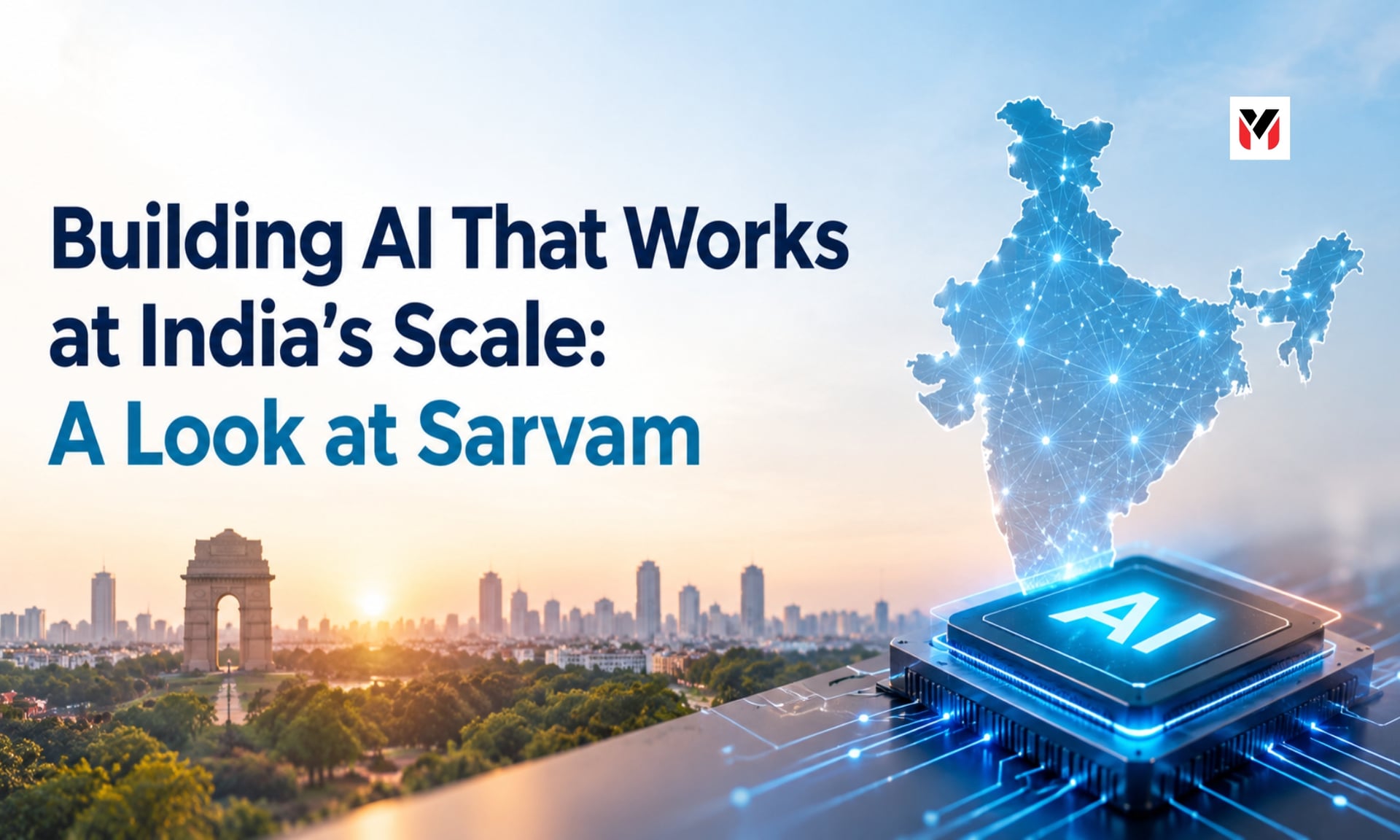
Multilingual script characters flowing into a neural network pattern over an outline of India · Editorial · Analysis preview.
Headline and Overview
Sarvam announced on 16 June 2026 that it had raised $234 million in the first close of a $300 million Series B round at a post-money valuation of $1.5 billion, according to exchange4media. HCLTech was the lead strategic investor, committing $150 million. Bessemer Venture Partners invested, and existing investors Khosla Ventures and Peak XV Partners continued their support. The company's co-founders are Pratyush Kumar and Vivek Raghavan.
What it builds
The company described several products. Sarvam 105B is a large model that the company says matches or outperforms larger reasoning models on benchmarks for knowledge, reasoning and agentic tasks. Sarvam 30B is optimised for use on edge devices and consumer hardware. Sarvam Vision handles handwriting and records in Indian languages and, the company said, has been used to digitise more than 35 million pages. Its speech models transcribe over half a million hours of audio each month. These are company claims; we did not test the models or see independent benchmark results.
The funds are meant for research on its next frontier model aimed at agentic, coding and cybersecurity use, and for compute at scale to expand its "forward-deployed" work across key sectors. A forward-deployed model means engineers work alongside customers to build and tune systems for them, which is slower than selling software but closer to the customer.
“AI that works at India's scale.”
Who said what
Pratyush Kumar spoke of building AI "that works at India's scale" and of a full-stack offering for enterprises to run their own sovereign AI. C Vijayakumar, HCLTech's chief executive, called the investment "a significant step toward building India's trusted and globally competitive AI ecosystem." Bessemer partner Pankaj Mitra said: "Sarvam is building and deploying India's sovereign AI platform."
Why watch: our analysis
1. A clear niche. Models that handle Indian languages, speech and handwriting address a large population that general-purpose global tools serve unevenly. 2. A strategic customer-investor. HCLTech is an IT services company with many enterprise clients, so its backing could open sales channels. It also creates a dependence worth watching. 3. Sovereignty as a selling point. Governments and regulated industries often want control over where data and models sit. If that demand grows, a domestic provider has an advantage. 4. Focus on deployment. Building with customers can produce stickier revenue than selling model access alone.
Risks
Training frontier models is expensive, and larger global competitors have far more capital. The exchange4media article said nothing about Sarvam's revenue, customers or profitability, so we cannot judge the business behind the valuation. Benchmarks do not guarantee commercial success, and the "sovereign" label needs to be matched by products that customers prefer on merit. The round was a first close of a larger target, so the final figure may differ.
Questions we would ask the company
What share of revenue comes from government versus private clients? How much of the work is repeatable software, and how much is custom engineering? What is the cost to serve a customer, and how does it change with scale? How does the company measure model quality in Indian languages, and who checks?
For founders and enterprises
For founders: The company's route, a technical core, a strategic investor with distribution and a clear national angle, is one model for deep-tech founders. It is not the only one, and it works best when the product solves a problem customers will pay to fix.
For enterprises considering AI vendors: Ask for references, test on your own data and understand where your data is processed. Our Digital Transformation piece on AI pilots offers a checklist.
How to read an AI funding announcement
Announcements of this kind combine several different things. The headline valuation is a negotiated price for a minority stake, not a measure of revenue. A "first close" means that the round is still open and the final total may be higher. A strategic investor can bring customers but may also want preferential terms. And the products named in the announcement are the company's own description. A careful reader looks for three additional facts: what customers pay, what it costs to serve them, and what the company would look like without the new capital. None of these appeared in the source we read, which is why we call this a watchlist entry, not an endorsement.
Independent editorial profile built from public reporting. Company claims are labelled as such.
- exchange4media, 'Sarvam raises $234M in first close of $300M Series B at $1.5B valuation', 16 June 2026
The Editorial Desk
Perspectives on the people, ideas and businesses shaping what comes next. The articles in this preview are illustrative samples, not reported journalism.
More from the Editorial Desk