One Flight, a Long Road: What Vikram-1 Tells Us About Building Deep Tech in India
A Hyderabad startup founded in 2018 has reached orbit. The achievement is real; the business case is still to be proved.
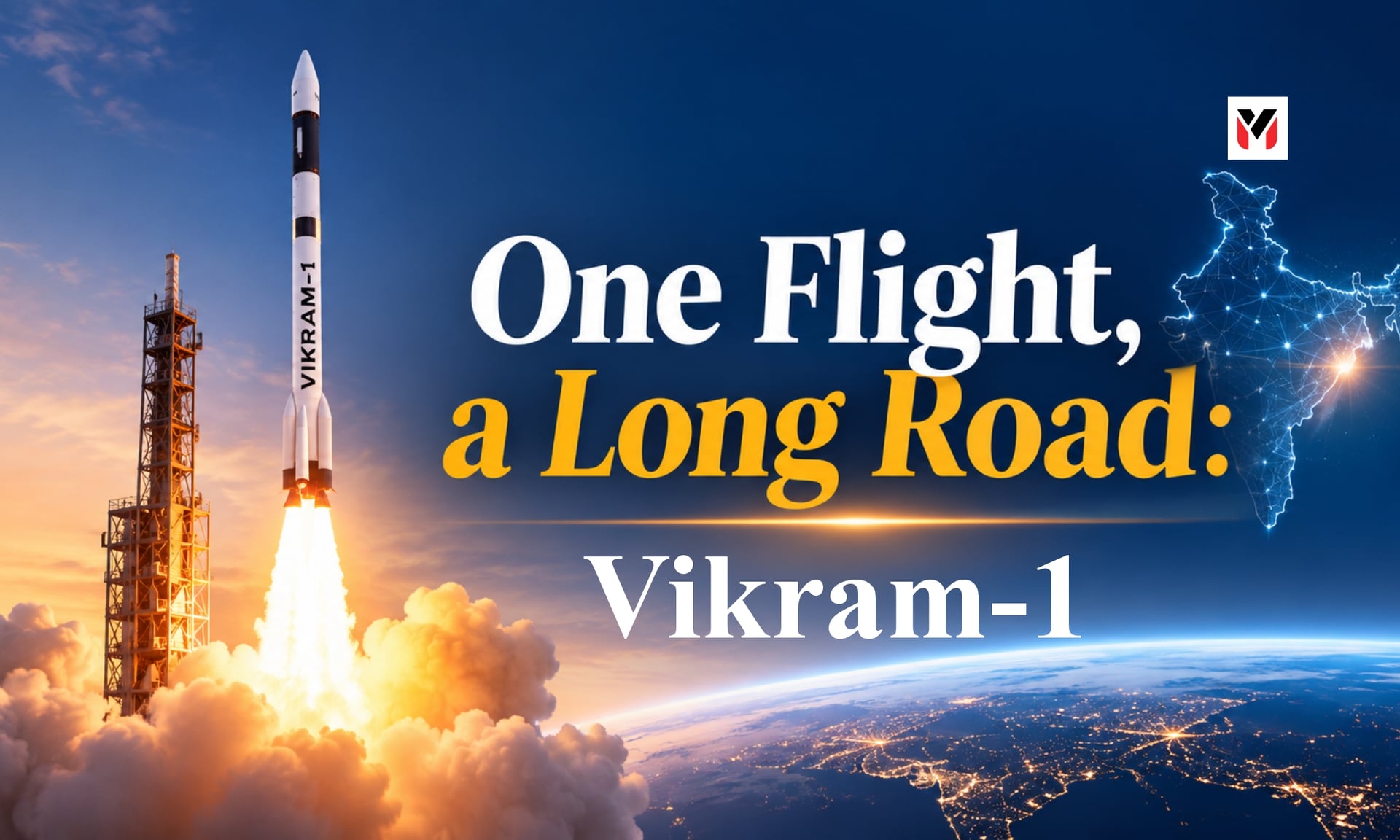
A rocket silhouette rising above a coastline with a simple orbit arc in charcoal and red palette · Editorial · Analysis preview.
The Orbital Launch from Sriharikota
On Saturday 18 July 2026, Skyroot Aerospace's Vikram-1 lifted off from the Satish Dhawan Space Centre at Sriharikota in Andhra Pradesh. Satellite Today reported that the launch took place at 12:05 p.m. local time and that Skyroot said the rocket reached 450 km at a 60-degree inclination.
Al Jazeera, reporting the same day, described a three-stage vehicle about 22 metres tall, and said customer payloads were deployed in low-Earth orbit at about 450 km. Satellite Today named payloads from Grahaa Space, Cosmoserve and DCubed, along with Skyroot's own SCOPE satellite, and noted that the orbit and deployment details came from Skyroot's post-launch confirmation without independent verification. We therefore treat them as company-reported.
The Vehicle and the Company
Vikram-1 is designed to place up to 350 kg into low-Earth orbit, according to both reports. Skyroot, founded in 2018 by former ISRO scientists, is based in Hyderabad. Satellite Today reported that it became India's first space unicorn in May 2026, at a valuation of $1.1 billion; Al Jazeera said it had earlier in 2026 become the first Indian space company to reach a $1 billion valuation.
The company's 2022 Vikram-S mission reached space but was suborbital. Satellite Today said Skyroot is developing Vikram-2, targeted for a first flight in 2027, with a capacity of up to 1,000 kg.
“Proves that India has the talent, the technology and the industrial strength.”
What Was Said: Industry and Government Reaction
Chief executive Pawan Kumar Chandana said the launch "proves that India has the talent, the technology and the industrial strength" to build launch vehicles, and said the company wants consecutive launches in a short time to establish the vehicle's reliability. Retired Lt Gen A K Bhatt, director general of the Indian Space Association, called the mission a "defining milestone."
Prime Minister Narendra Modi said it would "encourage countless youngsters to dream bigger and innovate fearlessly," according to Al Jazeera. Skyroot posted on X: "Hello space, we have arrived!"
Al Jazeera described India as the third country to reach orbital launch capability through private enterprise but did not name the other two, so we do not repeat the ranking as fact. It also said Skyroot's flight validated propulsion, avionics, telemetry, guidance, navigation and control, and that the company plans further test flights before routine commercial missions.
Our Reading: What the Achievement Does and Does Not Prove
A single successful flight proves that a private Indian team can build a rocket that works. It does not prove that the vehicle is reliable, that launches can be repeated at a cost that customers will pay, or that the company will earn a return on the capital it has raised.
The chief executive's own comments about the need for consecutive launches reflect that. In launch services, reliability is the product.
Four Lessons for Deep-Tech Founders: Our Framework
1. Policy opened the door, execution walked through it. The 2020 reforms that opened the space sector and created IN-SPACe gave private firms a path, as the coverage noted, but it took years of engineering to use it.
2. Patience is part of the plan. Eight years separate the founding from the orbital flight. Financing must match that horizon.
3. Test in public, but carefully. The 2022 suborbital flight built credibility and a track record before the orbital attempt.
4. Build the ecosystem. Skyroot flew customer payloads from other small companies. A launch provider needs customers as much as a customer needs a launcher.
Suppliers, Next Flights, and a Note on Caution
For suppliers and engineers: A launch vehicle uses composite structures, propulsion hardware, avionics and testing services. Suppliers of precision machining, composites, electronics and quality assurance, in places such as Hyderabad, Bengaluru and Pune, are the type of firm that benefits when a launch company grows.
What to watch: The next flights will say more than the first. Look for the interval between launches, the number of customers and the date of Vikram-2.
A note on celebration and caution: Moments like this attract strong language, and some is deserved. Putting a rocket into orbit is a hard engineering feat. But a good editor keeps two things apart: the achievement, which is documented, and the commercial outcome, which is not yet.
Early excitement has sometimes been followed by quiet years as companies work through the less visible tasks of manufacturing at volume, building a customer book and passing safety reviews. The healthiest response is to congratulate the team and ask for the second flight.
Editorial analysis. Orbit and payload details are as reported and, in part, company-confirmed.
- Satellite Today, 'Skyroot Aerospace Makes History for India With First Launch Success', 20 July 2026
- Al Jazeera, 'India achieves milestone with launch of first private-sector orbital rocket', 18 July 2026
- CivilsDaily, 'India's first private orbital launch marks a structural milestone' (background on 2020 reforms and 2022 Vikram-S)
The Editorial Desk
Perspectives on the people, ideas and businesses shaping what comes next. The articles in this preview are illustrative samples, not reported journalism.
More from the Editorial Desk