The Bharat Commerce Breakthrough: How Vidit Aatrey and Sanjeev Barnwal Built Meesho for the Next 500 Million
When global giants spent billions subsidising discounts for metro shoppers, IIT Delhi batchmates Vidit Aatrey and Sanjeev Barnwal looked at unbranded goods, Tier-3 town resellers, and small manufacturers. The result was a retail model India had never seen before.
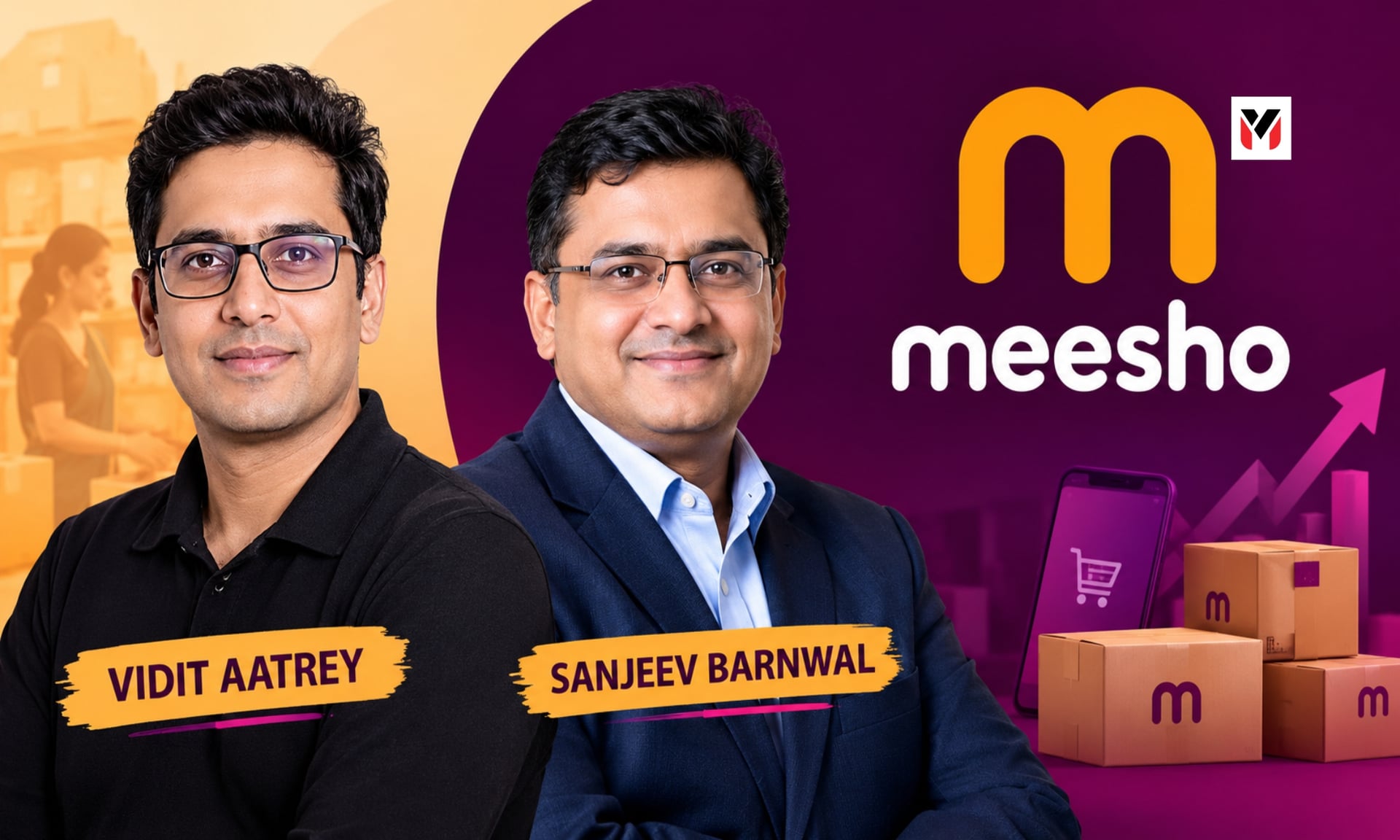
Vidit Aatrey and Sanjeev Barnwal, co-founders of Meesho, alongside the Meesho mobile app and delivery boxes · Editorial · Analysis preview.
Pivoting through failure to uncover Bharat's real trade
The founding saga of Meesho is a textbook study in disciplined iteration. When Fashnear flopped, the founders didn't blame customer adoption; they recognised that inventory logistics for fast-fashion in single neighbourhoods lacked unit economics.
By following user behaviour into WhatsApp groups, they realized that India's retail economy was propelled by trust and social curation. Millions of women across small towns possessed immense social capital but lacked formal employment. By giving them digital tools to act as micro-entrepreneurs, Meesho democratised retail distribution and entered the prestigious Y Combinator accelerator in 2016.
The zero-commission masterstroke
By 2021, established e-commerce giants charged sellers between 15% and 25% in commission fees, alongside advertising costs and warehouse storage rents. For small unbranded garment makers in Surat or footwear manufacturers in Agra, these tolls made e-commerce unprofitable.
Vidit Aatrey announced an industry-shaking move: Meesho would charge zero percent commission to sellers forever. The reaction from established competitors was disbelief; analysts questioned how a marketplace could survive without take rates.
Aatrey and Barnwal proved that a marketplace could monetise through high-intent seller advertising and optional value-added services. By eliminating commissions, Meesho attracted over 1.5 million small manufacturers, unlocking the lowest prices in the country and triggering explosive consumer growth.
“If an e-commerce model works only when you charge 20% commission to sellers, you haven't built technology; you've built a toll booth. Zero commission forced us to make our tech actually efficient.”
Engineering for the $100 smartphone
As CTO, Sanjeev Barnwal tackled a technological challenge foreign to Silicon Valley engineers: how to build an app that downloads in seconds on budget Android phones with 2GB RAM and functions flawlessly on congested 3G/4G networks.
Meesho's engineering team rebuilt the app architecture to keep the APK download size under 15 megabytes, engineered lightweight image compression algorithms, and eliminated heavy scripts. The result was an interface as fast and intuitive for a grandmother in Gorakhpur as for an engineer in Whitefield.
Valmo and the decentralised logistics revolution
Last-mile logistics in Tier-3 and Tier-4 towns had long been the cost graveyard of Indian e-commerce. Traditional national 3PL courier companies maintained expensive sorting hubs and rigid fee structures that pushed delivery costs above ₹70 per parcel.
In 2024, Meesho unveiled Valmo, a decentralised logistics network that partners directly with hundreds of regional micro-entrepreneurs and local courier operators. By aggregating local delivery partners through an intelligent routing algorithm, Valmo slashed logistics costs by over 20%, passing savings back to consumers and enabling Meesho to reach operational profitability.
Lessons for marketplace builders
• Observe what users do, not what they say: The greatest product pivots come from watching unprompted customer workarounds in the real world. • Align incentives with the smallest participant: When you make the smallest supplier in Surat profitable, supply-side network effects become invincible. • Frugality is a competitive weapon: Lowering your internal cost to serve allows you to win customer segments that competitors dismiss as unprofitable.
The long-term impact
Vidit Aatrey and Sanjeev Barnwal proved that e-commerce in India is not a zero-sum game confined to English-speaking metro elites. By empowering local manufacturing clusters and serving 150 million transacting households across Bharat, Meesho demonstrated how technology can truly democratise national commerce.
- Fashnear Technologies Pvt Ltd (Meesho) regulatory filings and annual performance disclosures, FY24–FY26.
- Valmo logistics network operational data, 2024–2026.
- Inc42, Economic Times, and YourStory investigative coverage of Bharat e-commerce dynamics.
The Editorial Desk
Perspectives on the people, ideas and businesses shaping what comes next. The articles in this preview are illustrative samples, not reported journalism.
More from the Editorial Desk