From Aligarh to the Heart of India's Wallets: Vijay Shekhar Sharma's Masterclass in Fintech Grit
From borrowing textbooks in engineering college to conquering hundreds of thousands of retail counters with the ubiquitous Soundbox, Vijay Shekhar Sharma built Paytm through sheer tenacity. Now he faces his toughest test: governance and post-regulatory renewal.
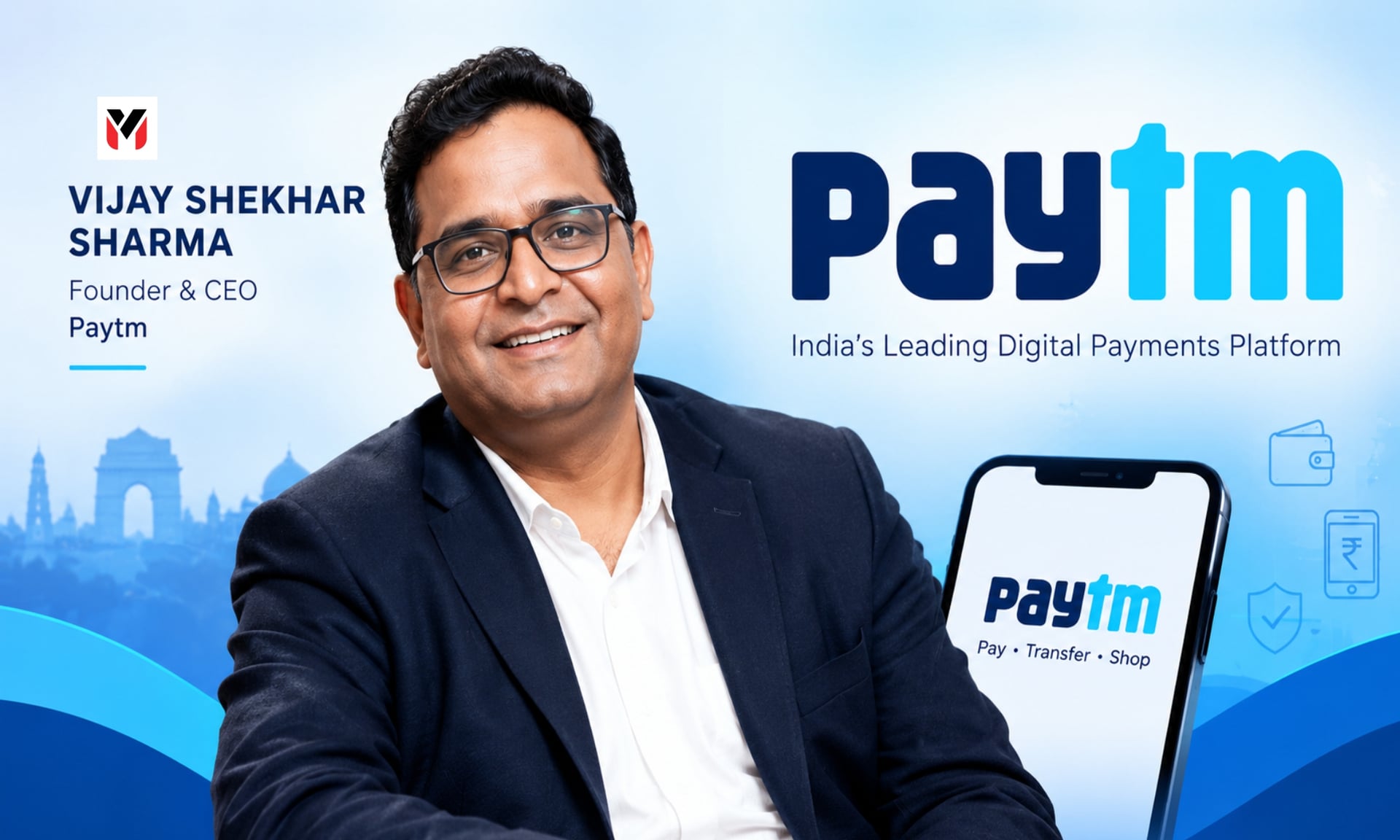
Vijay Shekhar Sharma, founder and CEO of Paytm, smiling beside the Paytm mobile payments app and logo · Editorial · Analysis preview.
The Aligarh roots and the telecom grind
Vijay Shekhar Sharma's early career was defined by raw survival. Arriving in Delhi without fluent English or family wealth, he survived on ten-rupee meals and skipped breakfasts while building his first internet venture, xs! Corporation, which he sold for half a million dollars in 1999.
When he founded One97 Communications in 2000, he found himself trapped in the brutal economics of telecom VAS, where telcos took up to 70% of revenue and delayed payments for months. It was a gruelling apprenticeship that taught Sharma three non-negotiable skills: obsessive cash management, the power of consumer distribution, and an instinct for shifts in telecom connectivity.
The wallet gamble and demonetisation blitz
In 2010, Sharma proposed investing ₹10 crore of One97's hard-earned cash into a digital consumer wallet. His board was sceptical, with some directors questioning why consumers would deposit money in an unproven mobile balance. Sharma offered to put his own equity on the line to back the project.
When demonetisation was announced on 8 November 2016, Paytm was ready. Within hours, full-page newspaper advertisements appeared, and Paytm's field teams mobilized. In three months, the platform added tens of millions of users and millions of merchant touchpoints, becoming the undisputed symbol of cashless India.
“Building in India requires surviving the shifts you cannot predict. When your distribution is real, every crisis gives you a chance to rebuild cleaner.”
The Soundbox: Hardware as a distribution moat
As UPI launched and peer-to-peer payments became zero-fee commodities, sceptics predicted Paytm's demise. Sharma's counterstroke was a piece of yellow and white plastic: the Paytm Soundbox.
Kirana shopkeepers in noisy bazaars frequently missed SMS confirmations and were vulnerable to fraudulent customer screens. The Soundbox announced transactions instantly in local languages: "Paytm par pachaas rupaye prapt hue." Crucially, Paytm charged merchants an upfront fee and a monthly rental of ₹100–125. In doing so, Sharma converted a cost centre into an annuity stream that reached over 10 million active devices.
The regulatory storm and the discipline of governance
Paytm's journey has not been without deep turbulence. Following its marquee 2021 IPO, the stock endured intense market corrections. In early 2024, the Reserve Bank of India imposed stringent restrictions on Paytm Payments Bank due to compliance and KYC irregularities, sending shockwaves through the ecosystem.
Sharma's response marked a profound shift in tone. Rather than fighting regulators in public, Paytm overhauled its board structure, severed operational ties with the Payments Bank, transitioned merchant settlement accounts to premier private banks, and doubled down on regulatory compliance. Operating revenue adjusted, non-core assets were divested, and cost structures were aggressively pruned.
Lessons for founders navigating high stakes
• Distribution is resilient: If small merchants rely on your hardware to run their daily livelihoods, they will not abandon you overnight if the core service remains uninterrupted. • Compliance is a core product feature: In regulated financial services, speed cannot compromise governance. A founder must evolve from an insurgent disruptor into an institutional custodian. • Grit outlasts sentiment: Markets fluctuate between euphoric valuation and cynical pessimism. The only metric that counts is whether your products continue to solve real friction for real people.
The enduring imprint
Vijay Shekhar Sharma's legacy is already written on millions of storefronts across India. From small pushcarts to high-street supermarkets, his belief in a cashless, digitally empowered India permanently reshaped the economic geography of the country.
- One97 Communications Ltd. BSE/NSE disclosures and quarterly investor presentations, FY24–FY27.
- RBI regulatory notifications on Payments Bank operational transitions, Jan–March 2024.
- NPCI UPI transaction volume dashboards and third-party merchant deployment metrics.
The Editorial Desk
Perspectives on the people, ideas and businesses shaping what comes next. The articles in this preview are illustrative samples, not reported journalism.
More from the Editorial Desk